How to Match an HTD Belt and Timing Pulley should be approached as a drive-system decision. The useful starting point is the mating belt and machine interface, followed by tooth count, working width, shaft mounting and duty conditions. This guide explains the checks that help an engineer or buyer turn match HTD belt and pulley into an RFQ that can be verified against a catalogue row or drawing.
Identify the Drive Before Comparing Dimensions
For match HTD belt and pulley, identify the complete belt marking before comparing pulley diameters. HTD is a curvilinear synchronous system and the nominal pitch must stay associated with its profile family. Record the driver and driven tooth counts when an existing ratio must be preserved. For a new drive, document the target speed ratio, driver speed and expected load before choosing tooth counts. This prevents a component-level decision from overriding the machine requirement.
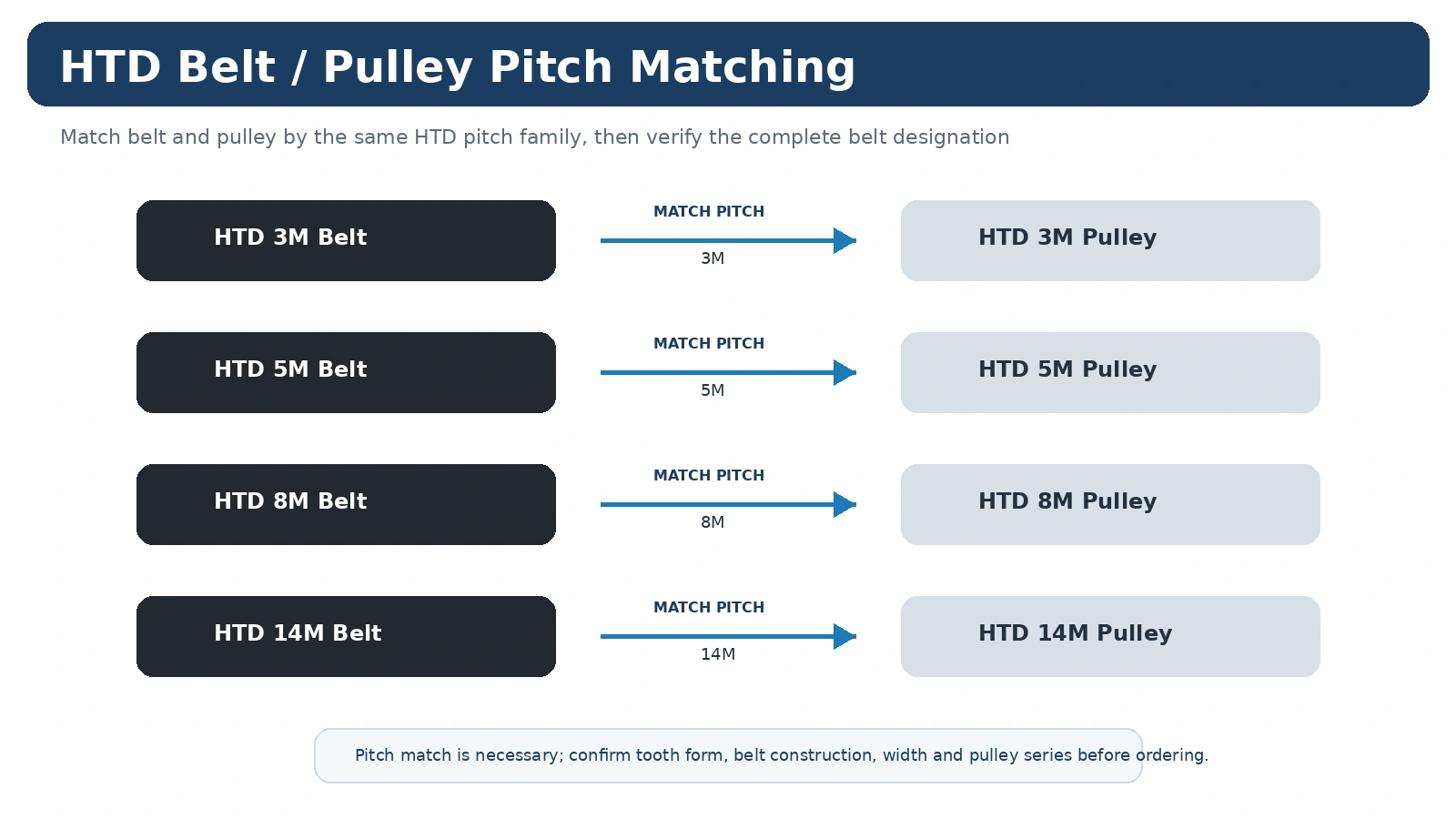
For a replacement project, compare the measured value with the installed belt and machine arrangement before deciding that a catalogue row is equivalent. For a new project, document the design basis so later maintenance teams can understand why the pitch, tooth count and mounting style were selected.
Dimensions That Control the Installation
A pulley can match pitch and tooth count yet still fail to fit the machine because the bore, hub, flange or axial position differs. Measure the shaft interface, belt-face width, hub projection on both sides and the belt line relative to a stable machine datum. Where a taper bush is used, record both the pulley series and bush code. Where a finished bore is required, include fit, keyway and any retaining method on the drawing.
For a replacement project, compare the measured value with the installed belt and machine arrangement before deciding that a catalogue row is equivalent. For a new project, document the design basis so later maintenance teams can understand why the pitch, tooth count and mounting style were selected.
Operating Conditions That Belong in the Selection
The same nominal match HTD belt and pulley component can see very different service depending on the machine. Starts per hour, reversing, shock loading, continuous operating time, temperature, contamination, cleaning and access for tensioning all influence the drive. A compact automation axis emphasizes repeatable motion and controlled alignment, while a conveyor or process machine may emphasize continuous duty and service access. Supply these conditions instead of asking the pulley to be selected from size alone.
For a replacement project, compare the measured value with the installed belt and machine arrangement before deciding that a catalogue row is equivalent. For a new project, document the design basis so later maintenance teams can understand why the pitch, tooth count and mounting style were selected.
Inspection Points Before Installation
Inspection should focus on dimensions that affect the drive: the shaft interface, axial location, tooth condition, face width and any drawing-controlled runout or datum relationship. A generic quality statement does not define acceptance. If a dimensional report, material document or order-specific record is required, identify it before production. During maintenance, watch for flange damage, edge wear, debris and signs that the pulley has moved on the shaft.
For a replacement project, compare the measured value with the installed belt and machine arrangement before deciding that a catalogue row is equivalent. For a new project, document the design basis so later maintenance teams can understand why the pitch, tooth count and mounting style were selected.
Open Questions to Close Before Ordering
What exact HTD profile and width is installed or specified?
What ratio or existing tooth count must be preserved?
What bore, fit, keyway or taper-bush arrangement is required?
How much hub projection and flange clearance is available?
What are the speed, load, starts, reversing and operating hours?
Which drawing, material or inspection records must accompany supply?
What to Send With the RFQ
Send profile, tooth count, belt width, shaft interface, hub/flange details, quantity, destination and a drawing or replacement measurement sketch. Add speed, ratio, load, center distance and environment for a new drive. Review the ایچ ٹی ڈی پروڈکٹ فیملیز، استعمال کریں۔ انتخاب گائیڈ, or compare the relevant application notes.
Match the Complete Belt Identity
The same nominal pitch number does not prove that every curvilinear belt profile is interchangeable. Keep the HTD designation, pitch, working width and available belt marking with the pulley request.
Keep measured values, catalogue references and project requirements clearly separated. If a required point is not stated in the relevant catalogue table or approved drawing, include it as an RFQ question or drawing requirement instead of filling the gap with a plausible but unverified value.
Check Both Sides of the Interface
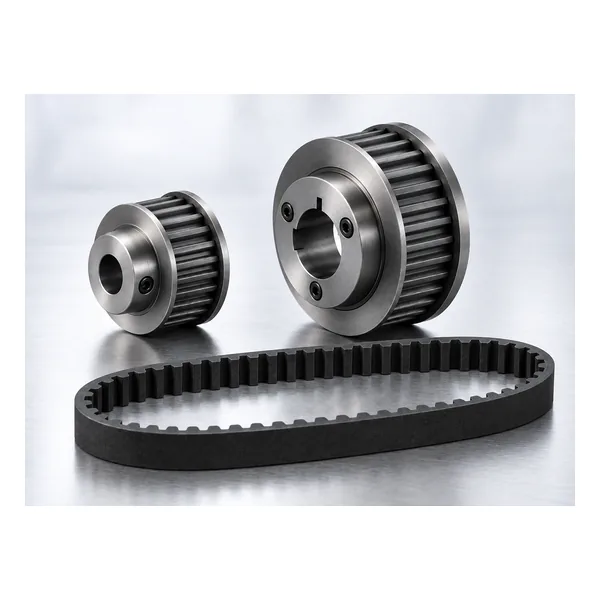
Compatibility has a belt side and a shaft side. After the belt family is confirmed, verify tooth count, pulley width, bore or bush, hub projection and flange arrangement. A pulley can mate with the belt yet still fail to install on the machine.
The purchasing record should keep a clear link between the machine requirement and the selected pulley. That means the complete belt or profile identity, tooth count, working width and shaft-interface information remain together with the product code. Any special material, finish, controlled tolerance, marking or report requirement should be stated separately so it cannot be mistaken for a universal feature of the whole family.
Procurement and Documentation
Once the selection is clear, keep the accepted product identity, quantity, destination and drawing revision on the same purchase line. Standard catalogue parts are normally planned around production-quantity minimums, while larger or higher-value items can be reviewed against the practical order value. Qualified new-client samples of 1–5 pieces may be reviewed at sample pricing when the configuration and manufacturing route are suitable.
Mixed-model orders can be consolidated toward a practical order value of about USD 1,500. Special materials and special processes follow the minimum quantity required by that process. Very small one- or two-piece requests are handled only as qualified engineering validation or paid-sample cases rather than retail replacement orders.
Lead time is confirmed after the technical definition is clear. Standard parts are typically planned at 10–25 business days, custom components at 20–45 business days, and project-based assemblies or related equipment at 45–120 business days where applicable. EXW, FOB, CIF and DAP are commonly supported; FCA, CFR, CPT, CIP and DDP can be discussed for suitable shipments. Treat these as planning ranges, not a shipment promise before order review.
A Practical Decision Sequence
Start with HTD family, pitch, width and complete belt marking. Keep the machine requirement separate from the catalogue choice: first identify what the drive must preserve, then compare only the rows or drawings that match that identity. This keeps a familiar-looking pulley from being accepted before its functional interfaces have been checked.
For an existing machine, preserve the original relationship before making changes. For a new design, record the target ratio, operating context and installation envelope so the belt/pulley match can be reviewed later without relying on memory or a photograph alone.
Build a Measurement Record
The most useful measurement set contains belt marking, pitch family, pulley tooth count and working width. Mark which values were measured on the machine and which values came from a catalogue or released drawing. When a feature is inaccessible, photograph its relationship to a stable datum and identify it as confirmation-required rather than filling the gap with an assumed value.
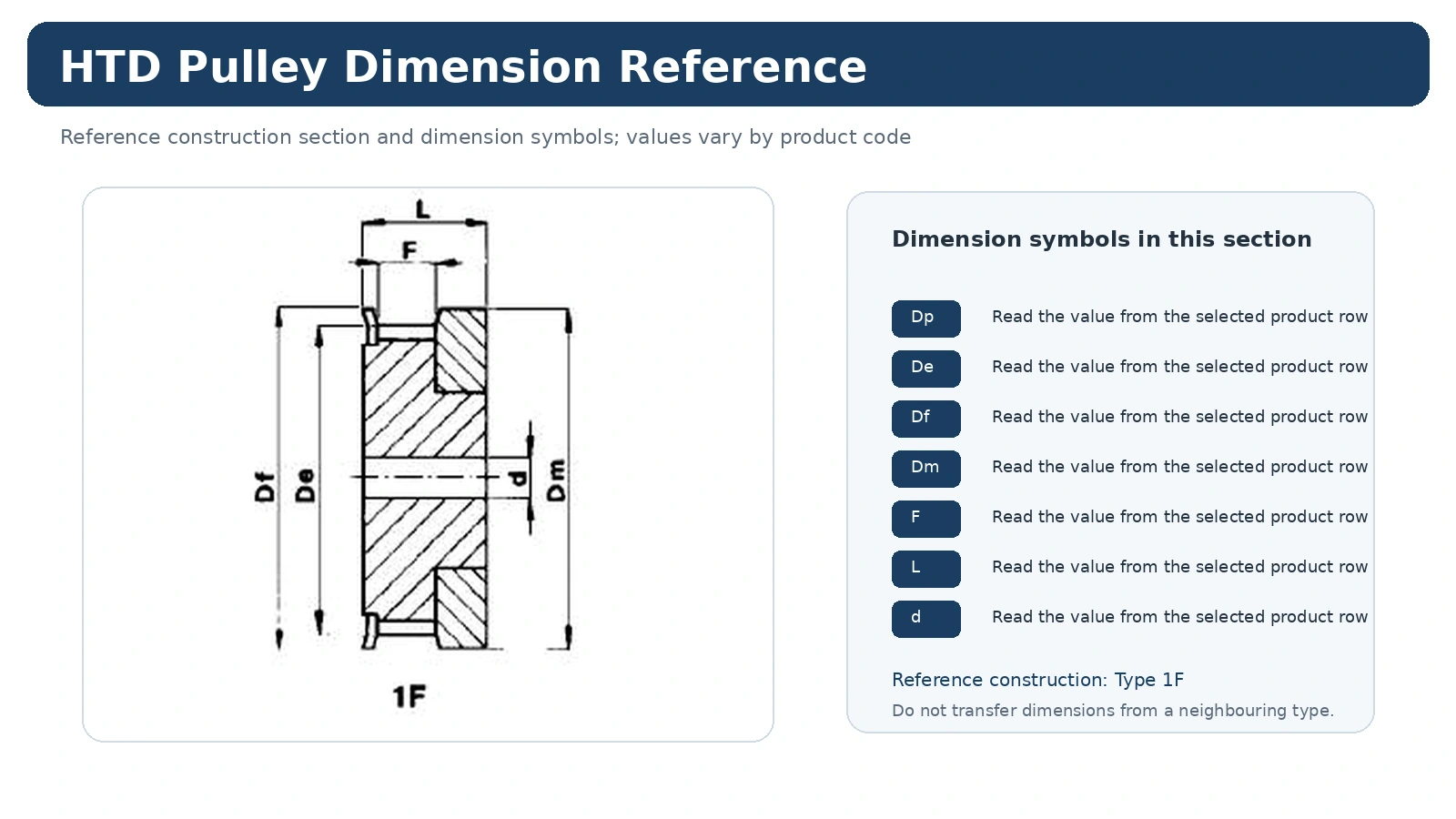
Dimension drawings should be viewed at full readable width. Never scale a screenshot and then treat the scaled dimension as a measurement; use the printed value and the correct construction type.
One Failure Mode Worth Avoiding
A common error is matching only the numerical pitch while ignoring tooth-system identity. That can produce a part that appears close in the catalogue yet changes ratio, belt line, mounting or service access. Resolve the conflicting feature before requesting price so the quotation refers to one mechanically coherent configuration.
If two candidate configurations remain possible, send both the machine measurements and photographs and the preferred option. The quotation can then identify which interface still needs confirmation instead of silently converting uncertainty into a specification.
Turn the Technical Choice Into a Quote-Ready Line Item
State the HTD/profile family and complete belt information.
Provide the tooth count, working width and relevant dimension or drawing references.
Define the bore or bush, shaft data, hub projection and belt-line position where applicable.
Add quantity, destination, required documents and the drawing revision used for the request.
When one item above is genuinely unknown, label it for confirmation. A precise open question is more useful than a plausible value that was never measured.
Questions Buyers Commonly Ask
What should be confirmed first?
Confirm HTD family, pitch, width and complete belt marking. That prevents later dimensions from being compared across the wrong product family or installation route.
What information is most useful for a replacement?
Send belt marking, pitch family, pulley tooth count and working width, plus clear photographs before the old pulley is removed. The photographs preserve axial orientation and neighboring clearances that a loose part cannot show.
When should a drawing be used?
Use a controlled drawing whenever the catalogue row does not completely define the shaft interface, hub/flange arrangement, finish, tolerance or inspection requirement that matters to the machine.
Keep Tooth-System Identity Intact
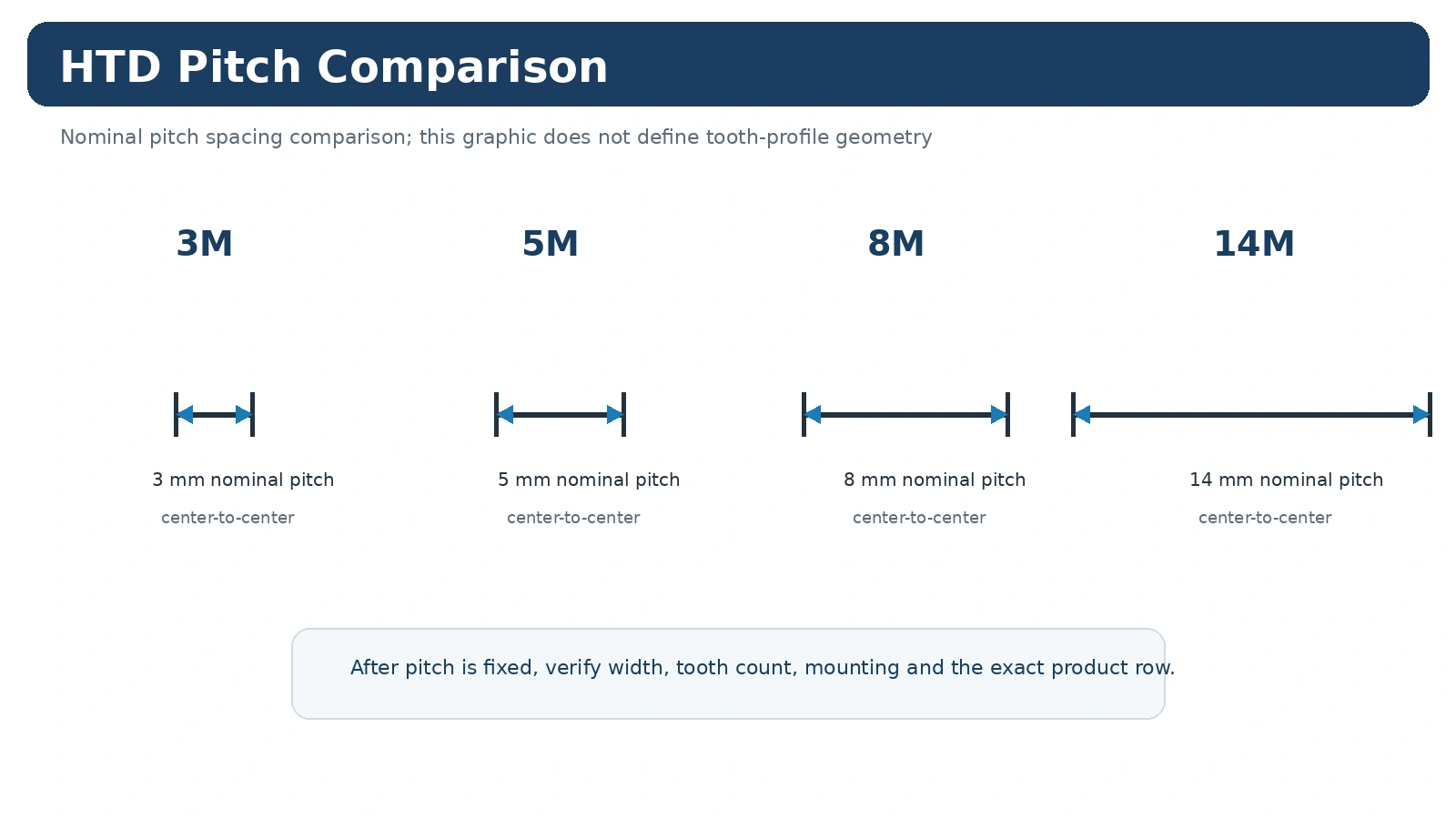
HTD is a curvilinear synchronous tooth family. The pitch designation tells you the center-to-center tooth spacing inside that family, but it does not make every belt with the same nominal pitch interchangeable. When an old drive is being identified, preserve the full belt marking and compare the pulley only inside the correct tooth family. This is especially important when the machine has been repaired previously and the visible pulley may not be the original part.
Once the tooth family is fixed, tooth count and belt width become practical catalogue decisions. The shaft connection is a separate layer: bore, taper bush, hub projection and flange arrangement determine whether the selected belt-side geometry will actually install in the machine.
Compatibility Is a Chain of Checks
A useful compatibility statement needs more than “same pitch.” Confirm tooth system, pitch, working width and tooth count first. Then confirm belt line, shaft interface, axial envelope and construction type. If the old part is not identifiable, treat the new part as a drawing-controlled replacement rather than forcing a weak cross-reference.
This sequence also improves purchasing. A buyer can send one complete line containing belt/profile identity, pulley series, tooth count and mounting details instead of separate messages that can become detached from one another.
Use the Complete Belt Identity Before Looking for a Pulley Code
A shared pitch number is necessary but not always sufficient for replacement. Start from the complete belt marking and establish the intended HTD family, pitch and width. Only then compare pulley tooth count and construction. This order avoids choosing a pulley from diameter or tooth appearance first and discovering later that the belt profile or width does not correspond to the selected family.
For an installed drive, inspect both components. Uneven belt-edge wear, polished flange faces or localized tooth wear can indicate alignment, contamination or tension issues that a new pulley alone will not correct. Preserve the belt line during measurement and check whether the existing pulley has moved on the shaft or whether a spacer has changed the axial position.
For a new drive, provide the speed relationship, center distance, duty and shaft arrangement along with the belt family. Those machine inputs determine whether a catalogue pulley is a practical match even after the basic profile compatibility has been established.
Inspect the Existing Pair as a System Before Ordering Only One Component
If either the belt or pulley shows unusual wear, inspect the mating component before deciding to replace only one item. A new belt on a damaged tooth surface can inherit the old wear pattern, while a new pulley installed with a degraded belt may not give a useful indication of the real drive condition.
Keep the belt marking, width and length information with the pulley tooth count and width series in the maintenance record. That record makes future identification faster and reduces the risk of matching a belt and pulley only because they share a nominal pitch number.
Match the Complete Belt Identity Before Comparing Pulley Dimensions
A synchronous belt and pulley must belong to the same intended tooth system. Nominal pitch is a first check, but it should not be used by itself to declare compatibility with every curvilinear profile that shares a similar pitch number. Keep the full belt designation, working width and any manufacturer-specific profile information with the pulley selection.
For a replacement, a worn belt may no longer show its marking clearly. In that case, document the installed pulley, tooth count, width and visible tooth geometry and compare them with reliable records before ordering. For a new drive, use the belt manufacturer sizing method and select the pulley family that is explicitly intended for that belt system.
Confirm the HTD family and complete belt designation.
Check 3M, 5M, 8M or 14M as applicable, without treating pitch alone as interchange proof.
Keep belt working width and pulley width family on the same order line.
Replace damaged or contaminated mating components when their condition would compromise the new part.
If the belt identity remains uncertain, send clear close-up photographs and the machine information rather than guessing. The quotation can then identify which detail must be confirmed before a pulley is released for production.