HTD 14M Timing Pulley Selection Guide should be approached as a drive-system decision. The useful starting point is the mating belt and machine interface, followed by tooth count, working width, shaft mounting and duty conditions. This guide explains the checks that help an engineer or buyer turn HTD 14M timing pulley selection into an RFQ that can be verified against a catalogue row or drawing.
Zidentyfikuj napęd przed porównaniem wymiarów
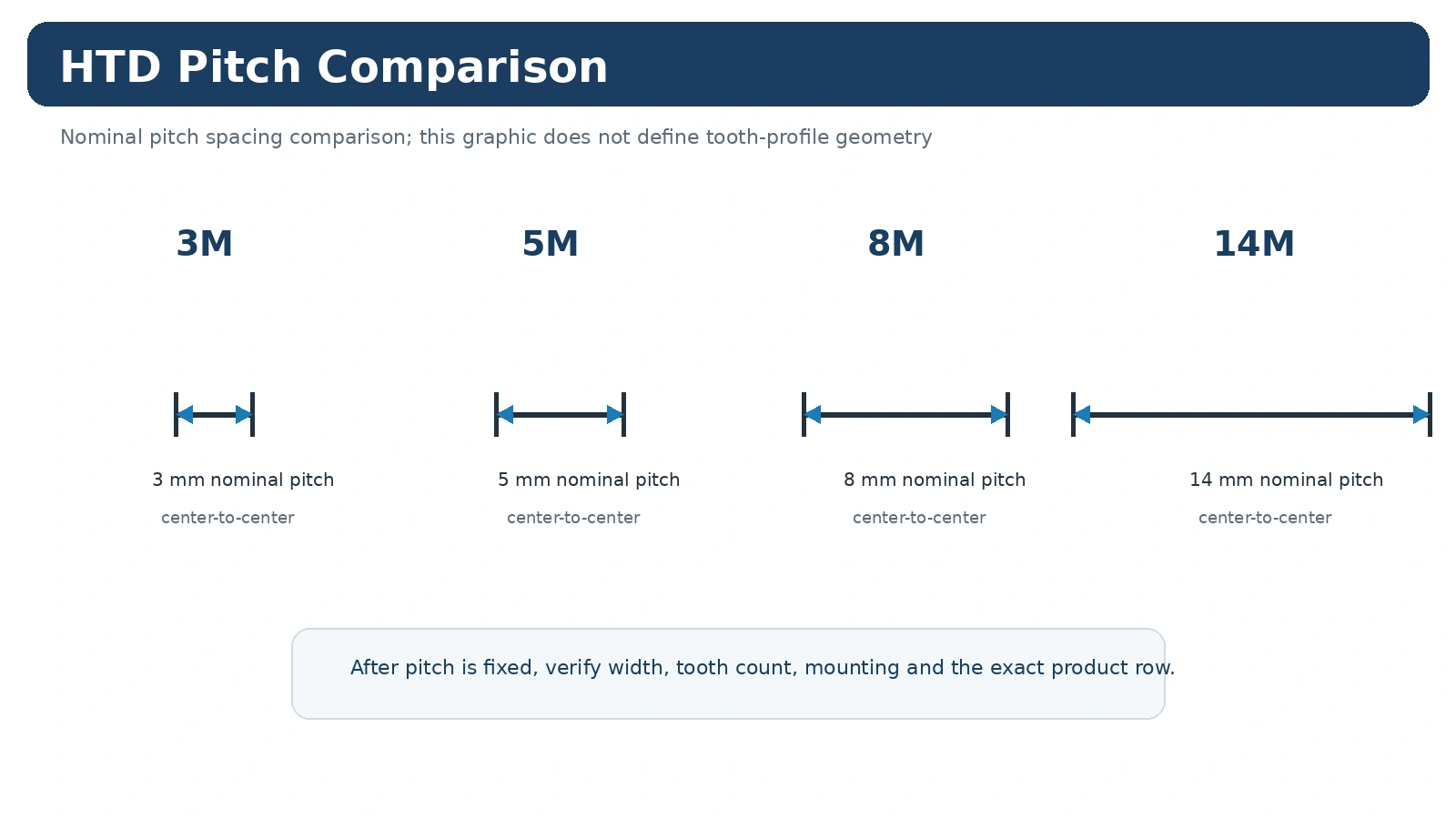
For HTD 14M timing pulley selection, identify the complete belt marking before comparing pulley diameters. HTD is a curvilinear synchronous system and the nominal pitch must stay associated with its profile family. Record the driver and driven tooth counts when an existing ratio must be preserved. For a new drive, document the target speed ratio, driver speed and expected load before choosing tooth counts. This prevents a component-level decision from overriding the machine requirement.
W przypadku projektu wymiany należy porównać zmierzoną wartość z zainstalowanym pasem i układem maszyny, zanim zdecyduje się, że katalogowy rząd jest równoważny. W przypadku nowego projektu należy udokumentować podstawę projektu, aby późniejsze zespoły konserwacyjne mogły zrozumieć, dlaczego wybrano taką podziałkę, liczbę zębów i sposób mocowania.
Wymiary kontrolujące instalację
Koło pasowe może pasować pod względem podziałki i liczby zębów, ale mimo to nie będzie pasować do maszyny z powodu różnicy otworu, piasty, kołnierza lub położenia osiowego. Zmierz powierzchnię styku wału, szerokość powierzchni czołowej pasa, wystawanie piasty po obu stronach oraz linię pasa względem stabilnego punktu odniesienia maszyny. W przypadku zastosowania tulei stożkowej, zanotuj zarówno serię koła pasowego, jak i kod tulei. W przypadku konieczności wykonania otworu gotowego, uwzględnij na rysunku pasowanie, rowek wpustowy i ewentualną metodę mocowania.
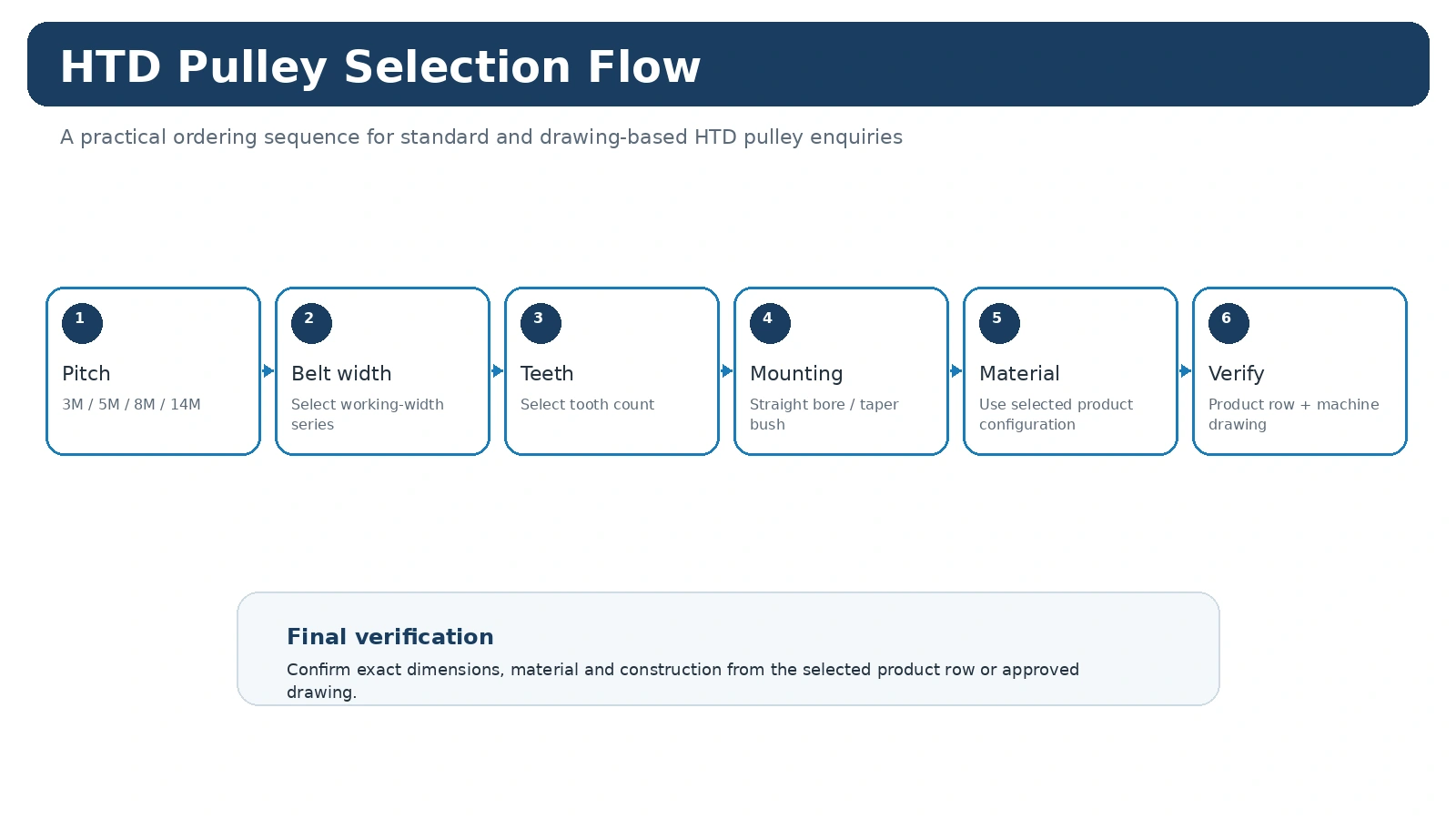
W przypadku projektu wymiany należy porównać zmierzoną wartość z zainstalowanym pasem i układem maszyny, zanim zdecyduje się, że katalogowy rząd jest równoważny. W przypadku nowego projektu należy udokumentować podstawę projektu, aby późniejsze zespoły konserwacyjne mogły zrozumieć, dlaczego wybrano taką podziałkę, liczbę zębów i sposób mocowania.
Warunki pracy, które należą do wyboru
The same nominal HTD 14M timing pulley selection component can see very different service depending on the machine. Starts per hour, reversing, shock loading, continuous operating time, temperature, contamination, cleaning and access for tensioning all influence the drive. A compact automation axis emphasizes repeatable motion and controlled alignment, while a conveyor or process machine may emphasize continuous duty and service access. Supply these conditions instead of asking the pulley to be selected from size alone.
W przypadku projektu wymiany należy porównać zmierzoną wartość z zainstalowanym pasem i układem maszyny, zanim zdecyduje się, że katalogowy rząd jest równoważny. W przypadku nowego projektu należy udokumentować podstawę projektu, aby późniejsze zespoły konserwacyjne mogły zrozumieć, dlaczego wybrano taką podziałkę, liczbę zębów i sposób mocowania.
Punkty kontrolne przed instalacją
Kontrola powinna koncentrować się na wymiarach wpływających na napęd: styku wału, położeniu osiowym, stanie zębów, szerokości czoła oraz wszelkich biciach lub zależnościach bazowych określonych na rysunku. Ogólne oświadczenie jakościowe nie definiuje akceptacji. Jeśli wymagany jest raport wymiarowy, dokument materiałowy lub dokumentacja dotycząca konkretnego zamówienia, należy go zidentyfikować przed rozpoczęciem produkcji. Podczas konserwacji należy zwracać uwagę na uszkodzenia kołnierza, zużycie krawędzi, zanieczyszczenia i oznaki przesunięcia koła pasowego na wale.
W przypadku projektu wymiany należy porównać zmierzoną wartość z zainstalowanym pasem i układem maszyny, zanim zdecyduje się, że katalogowy rząd jest równoważny. W przypadku nowego projektu należy udokumentować podstawę projektu, aby późniejsze zespoły konserwacyjne mogły zrozumieć, dlaczego wybrano taką podziałkę, liczbę zębów i sposób mocowania.
Pytania otwarte do zamknięcia przed złożeniem zamówienia
Jaki dokładnie profil i szerokość HTD jest zainstalowany lub określony?
Jaki stosunek lub istniejącą liczbę zębów należy zachować?
Jaki otwór, pasowanie, wpust lub układ tulei stożkowej jest wymagany?
Jaki jest dostępny luz piasty i kołnierza?
Jakie są prędkości, obciążenie, uruchomienia, cofanie i godziny pracy?
Jakie rysunki, materiały lub protokoły kontroli muszą towarzyszyć dostawie?
Co wysłać wraz z zapytaniem ofertowym
Prześlij profil, liczbę zębów, szerokość pasa, styk wału, szczegóły piasty/kołnierza, ilość, miejsce przeznaczenia oraz rysunek lub szkic wymiarów zastępczych. Dodaj prędkość, przełożenie, obciążenie, rozstaw osi i środowisko dla nowego napędu. Przejrzyj Rodziny produktów HTD, użyj przewodnik wyborulub porównaj odpowiednie notatki aplikacyjne.
14M Selection Priorities
The 14M range is organised as 14M-40, 14M-55, 14M-85, 14M-115 and 14M-170. At this scale, overall envelope, hub construction, shaft interface and service access deserve early attention.
Należy wyraźnie oddzielić wartości pomiarowe, odniesienia katalogowe i wymagania projektu. Jeśli wymagany punkt nie jest wymieniony w odpowiedniej tabeli katalogowej lub zatwierdzonym rysunku, należy go uwzględnić jako pytanie w zapytaniu ofertowym lub wymaganie dotyczące rysunku, zamiast wypełniać lukę wiarygodną, ale niezweryfikowaną wartością.
Large Pulley Replacement Needs Installation Planning
Before removing a large pulley, document lifting/access constraints, shaft-end condition, axial references and the method available for removal. A model match on teeth and width is not enough if the replacement cannot be installed or serviced in the machine.
Dokument zakupu powinien wyraźnie powiązać wymagania maszyny z wybranym kołem pasowym. Oznacza to, że pełna identyfikacja pasa lub profilu, liczba zębów, szerokość robocza i informacje o styku wału z kodem produktu pozostają wraz z kodem produktu. Wszelkie wymagania dotyczące specjalnego materiału, wykończenia, kontrolowanej tolerancji, oznakowania lub raportu powinny być podane osobno, aby nie można ich było pomylić z cechami uniwersalnymi dla całej rodziny.
Zamówienia i Dokumentacja
Po dokonaniu wyboru należy zachować zaakceptowaną tożsamość produktu, ilość, miejsce przeznaczenia i wersję rysunku w ramach tej samej linii zakupowej. Standardowe części katalogowe są zazwyczaj planowane w oparciu o minimalne ilości produkcyjne, natomiast większe lub droższe pozycje można porównać z praktyczną wartością zamówienia. Zakwalifikowane próbki dla nowych klientów, w ilości 1–5 sztuk, można porównać z ceną próbną, jeśli konfiguracja i sposób produkcji są odpowiednie.
Zamówienia w modelu mieszanym można skonsolidować do praktycznej wartości zamówienia wynoszącej około 1500 USD. Materiały specjalne i procesy specjalne podlegają minimalnej ilości wymaganej przez dany proces. Bardzo małe zamówienia obejmujące jedną lub dwie sztuki są obsługiwane wyłącznie w ramach kwalifikowanej walidacji inżynieryjnej lub w ramach płatnych próbek, a nie jako zamówienia detaliczne na wymianę.
Czas realizacji zamówienia jest potwierdzany po ustaleniu szczegółów technicznych. Standardowe części są zazwyczaj planowane na 10–25 dni roboczych, komponenty niestandardowe na 20–45 dni roboczych, a zespoły projektowe lub powiązany sprzęt na 45–120 dni roboczych, w zależności od przypadku. Standardy EXW, FOB, CIF i DAP są powszechnie obsługiwane; w przypadku odpowiednich dostaw można omówić warunki FCA, CFR, CPT, CIP i DDP. Należy traktować je jako zakresy planowania, a nie obietnicę dostawy przed przeglądem zamówienia.
Praktyczna sekwencja decyzyjna
Start with 14 mm HTD family, width code, tooth count and installation envelope. Keep the machine requirement separate from the catalogue choice: first identify what the drive must preserve, then compare only the rows or drawings that match that identity. This keeps a familiar-looking pulley from being accepted before its functional interfaces have been checked.
For an existing machine, preserve the original relationship before making changes. For a new design, record the target ratio, operating context and installation envelope so the 14M selection can be reviewed later without relying on memory or a photograph alone.
Zbuduj rekord pomiarów
The most useful measurement set contains 14M belt marking, tooth count, width series, shaft interface and available axial space. Mark which values were measured on the machine and which values came from a catalogue or released drawing. When a feature is inaccessible, photograph its relationship to a stable datum and identify it as confirmation-required rather than filling the gap with an assumed value.
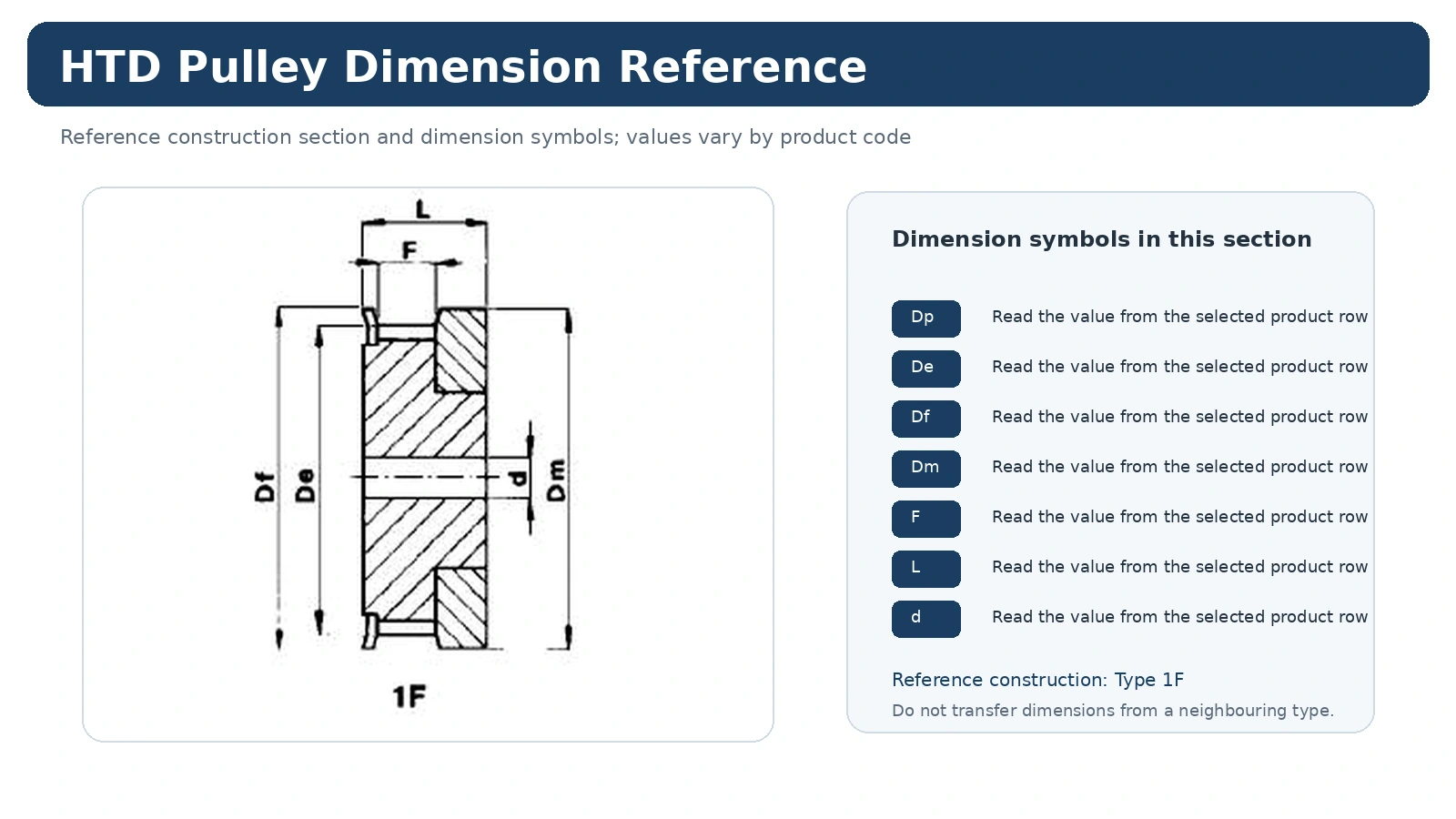
Rysunki wymiarowe należy oglądać w pełnej, czytelnej szerokości. Nigdy nie skaluj zrzutu ekranu i nie traktuj skalowanego wymiaru jako pomiaru; użyj wydrukowanej wartości i prawidłowego typu konstrukcji.
Jeden tryb awarii, którego warto unikać
A common error is assuming all large 14M pulleys use the same hub or bush arrangement. That can produce a part that appears close in the catalogue yet changes ratio, belt line, mounting or service access. Resolve the conflicting feature before requesting price so the quotation refers to one mechanically coherent configuration.
Jeśli nadal możliwe są dwie konfiguracje, należy przesłać zarówno pomiary i zdjęcia maszyny, jak i preferowaną opcję. Wycena pozwoli zidentyfikować interfejs, który nadal wymaga potwierdzenia, zamiast po cichu przekształcać niepewność w specyfikację.
Zmień wybór techniczny w pozycję zamówienia gotową do wyceny
Podaj rodzinę HTD/profilu i pełne informacje o pasie.
Podaj liczbę zębów, szerokość roboczą i odpowiednie wymiary lub odniesienia do rysunków.
Zdefiniuj otwór lub tuleję, dane wału, wysunięcie piasty i położenie linii pasa, tam gdzie ma to zastosowanie.
Dodaj ilość, miejsce przeznaczenia, wymagane dokumenty i wersję rysunku użytą w żądaniu.
Jeśli jeden z powyższych elementów jest rzeczywiście nieznany, oznacz go, aby potwierdzić. Precyzyjne pytanie otwarte jest bardziej przydatne niż prawdopodobna wartość, która nigdy nie została zmierzona.
Pytania, które często zadają kupujący
Co należy potwierdzić w pierwszej kolejności?
Confirm 14 mm HTD family, width code, tooth count and installation envelope. That prevents later dimensions from being compared across the wrong product family or installation route.
Jakie informacje są najbardziej przydatne w przypadku wymiany?
Send 14M belt marking, tooth count, width series, shaft interface and available axial space, plus clear photographs before the old pulley is removed. The photographs preserve axial orientation and neighboring clearances that a loose part cannot show.
Kiedy należy użyć rysunku?
Użyj rysunku kontrolowanego, jeśli wiersz katalogu nie definiuje w pełni interfejsu wału, układu piasty/kołnierza, wykończenia, tolerancji lub wymagań kontrolnych, które mają znaczenie dla maszyny.
Pitch Family Is Only the First Branch of the Selection
14M selection still requires working width, tooth count and mounting geometry. Tooth count changes pitch diameter and can also coincide with changes in body type, hub and material across a catalogue family. The correct comparison therefore stays row-specific after the pitch has been chosen. For a new drive, ratio and center distance must be reviewed together with available diameter and guard clearance.
For a replacement, begin with the mating belt and the installed part. If the belt identity is uncertain, avoid choosing a new family only because the measured pitch appears close. Obtain enough measurements and identification detail to identify the tooth system before comparing product rows.
When to Escalate From a Catalogue Row to a Drawing
Use a drawing-controlled order when the shaft connection, hub position, flange arrangement, material, finish or inspection requirement differs from the normal catalogue configuration. Keep standard HTD tooth geometry explicit on the drawing so the custom machining request does not accidentally obscure the mating-belt requirement.
On mixed-model RFQs, keep every width and tooth count on its own line. A general note such as “same as above” can become unsafe once one model uses a different construction type or bush.
Treat 14M Selection as an Envelope and Handling Decision as Well as a Pitch Choice
The 14M catalogue families include 14M-40, 14M-55, 14M-85, 14M-115 and 14M-170 width-series pages. These larger components deserve a deliberate envelope check because hub, flange, shaft and guard relationships can become as important to installation as the tooth count itself. Use the individual row and construction type rather than extrapolating from a smaller 14M part.
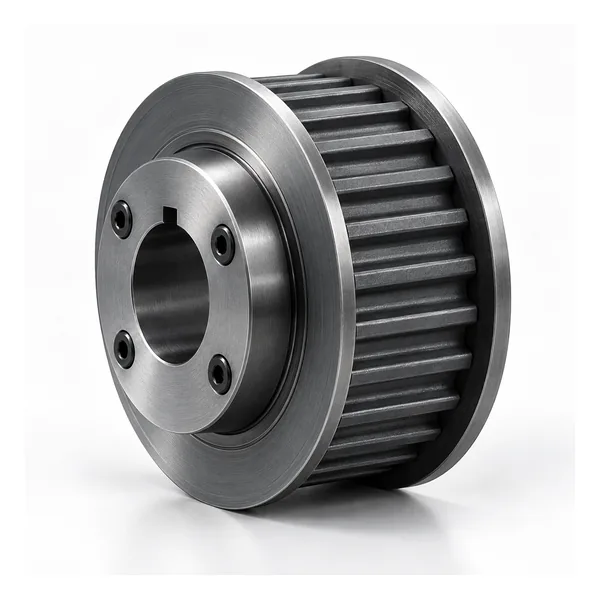
For replacement work, capture the pulley position on the shaft before removal and measure clearances to bearings, guards and adjacent components. If lifting, handling or disassembly space is limited, include that service context with the RFQ. Taper-bush configurations should be tied to the supported bush designation and actual shaft rather than selected from outside diameter.
For new drives, include ratio, center distance, transmitted duty and installation envelope. The website can identify the catalogue family and geometry, while the project data closes the machine-specific decision.
Check Handling and Installation Sequence for the Selected 14M Configuration
As the pulley envelope becomes larger, the installation sequence can matter. Confirm that the selected component can pass through the available guard opening and that there is sufficient space to position it on the shaft without disturbing unrelated components. Where lifting or support is needed, follow the machine owner’s safe handling method rather than improvising from the pulley catalogue.
The purchasing record should also distinguish the catalogue geometry from project-specific requirements. If the machine requires a particular finish, inspection report or shaft fit, add that requirement to the drawing or RFQ. Keep it tied to the exact 14M width series and tooth-count row so a future replacement does not inherit an ambiguous general note.
Plan 14M Selection Around the Full Industrial Envelope
The 14M family covers 14M-40, 14M-55, 14M-85, 14M-115 and 14M-170 width-series pages. These are physically larger components, so shaft size, hub projection, guard clearance, lifting/handling access and the selected construction type deserve the same attention as pitch and tooth count.
A large pulley can satisfy the belt-side requirements yet still be impractical to install if the hub, bush or removal space is overlooked. Replacement work should therefore include measurements from both shaft ends and the available axial envelope. For new drives, resolve the belt system and ratio first, then use the product row to control the actual pulley geometry.
Keep 40, 55, 85, 115 or 170 on the same line as the tooth count.
Compare type, hub and flange arrangement for the exact row.
Confirm straight-bore or taper-bush interface and actual shaft data.
Review installation and removal access for the selected diameter and width.
If a standard 14M row does not fit the machine envelope, use a drawing-controlled configuration rather than modifying a catalogue value informally. The drawing should identify which geometry is functional and which dimensions may remain standard.