HTD 14M Timing Pulley Selection Guide should be approached as a drive-system decision. The useful starting point is the mating belt and machine interface, followed by tooth count, working width, shaft mounting and duty conditions. This guide explains the checks that help an engineer or buyer turn HTD 14M timing pulley selection into an RFQ that can be verified against a catalogue row or drawing.
Identificeer de drijfveer voordat u dimensies vergelijkt.
For HTD 14M timing pulley selection, identify the complete belt marking before comparing pulley diameters. HTD is a curvilinear synchronous system and the nominal pitch must stay associated with its profile family. Record the driver and driven tooth counts when an existing ratio must be preserved. For a new drive, document the target speed ratio, driver speed and expected load before choosing tooth counts. This prevents a component-level decision from overriding the machine requirement.
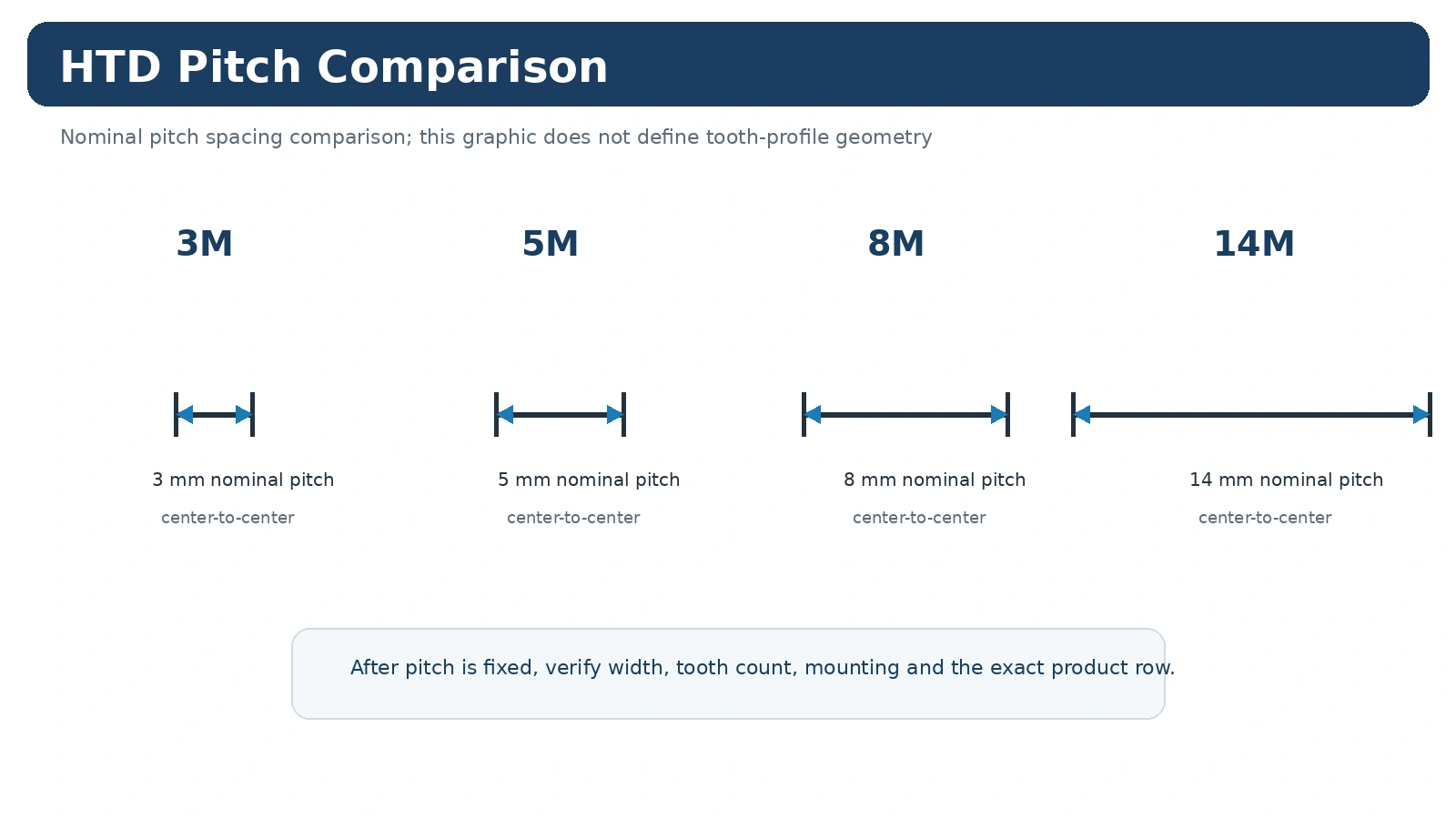
Bij een vervangingsproject moet de gemeten waarde worden vergeleken met de geïnstalleerde riem en machineconfiguratie voordat wordt besloten of een catalogusregel equivalent is. Bij een nieuw project moet de ontwerpbasis worden gedocumenteerd, zodat latere onderhoudsteams kunnen begrijpen waarom de steek, het aantal tanden en de montagewijze zijn gekozen.
Afmetingen die de installatie bepalen
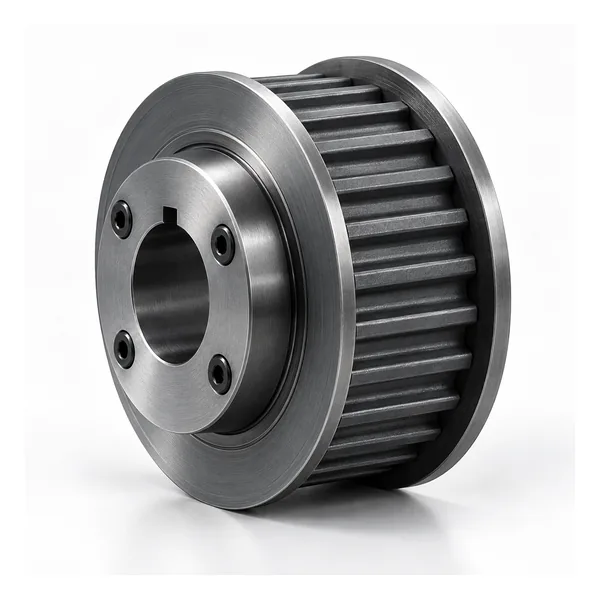
Een poelie kan qua steek en aantal tanden overeenkomen, maar toch niet op de machine passen omdat de boring, naaf, flens of axiale positie verschilt. Meet de asinterface, de breedte van het riemvlak, de naafuitsteeksel aan beide zijden en de riemlijn ten opzichte van een stabiel referentiepunt op de machine. Als een conische bus wordt gebruikt, noteer dan zowel de poelieserie als de buscode. Indien een afgewerkte boring vereist is, vermeld dan de passing, de spiebaan en eventuele bevestigingsmethode op de tekening.
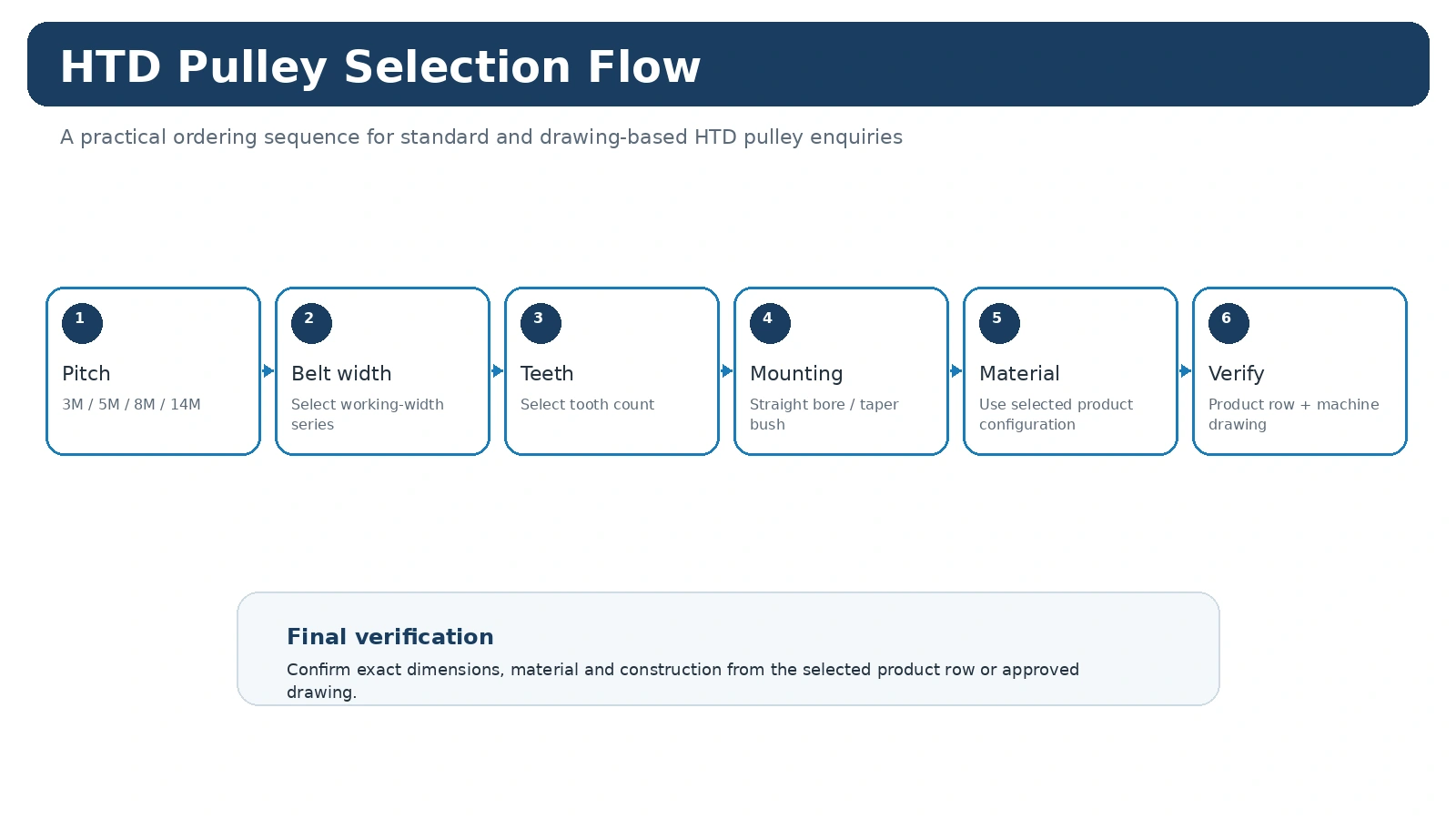
Bij een vervangingsproject moet de gemeten waarde worden vergeleken met de geïnstalleerde riem en machineconfiguratie voordat wordt besloten of een catalogusregel equivalent is. Bij een nieuw project moet de ontwerpbasis worden gedocumenteerd, zodat latere onderhoudsteams kunnen begrijpen waarom de steek, het aantal tanden en de montagewijze zijn gekozen.
Bedrijfsomstandigheden die bij de selectie horen
The same nominal HTD 14M timing pulley selection component can see very different service depending on the machine. Starts per hour, reversing, shock loading, continuous operating time, temperature, contamination, cleaning and access for tensioning all influence the drive. A compact automation axis emphasizes repeatable motion and controlled alignment, while a conveyor or process machine may emphasize continuous duty and service access. Supply these conditions instead of asking the pulley to be selected from size alone.
Bij een vervangingsproject moet de gemeten waarde worden vergeleken met de geïnstalleerde riem en machineconfiguratie voordat wordt besloten of een catalogusregel equivalent is. Bij een nieuw project moet de ontwerpbasis worden gedocumenteerd, zodat latere onderhoudsteams kunnen begrijpen waarom de steek, het aantal tanden en de montagewijze zijn gekozen.
Controlepunten vóór installatie
De inspectie moet zich richten op afmetingen die van invloed zijn op de aandrijving: de asinterface, axiale positie, tandconditie, tandbreedte en eventuele door de tekening bepaalde slingering of referentiepuntrelatie. Een algemene kwaliteitsverklaring is geen garantie voor acceptatie. Indien een dimensionaal rapport, materiaaldocument of orderspecifiek document vereist is, dient u dit vóór de productie aan te geven. Let tijdens het onderhoud op beschadiging van de flens, slijtage van de randen, vuil en tekenen dat de poelie op de as is verschoven.
Bij een vervangingsproject moet de gemeten waarde worden vergeleken met de geïnstalleerde riem en machineconfiguratie voordat wordt besloten of een catalogusregel equivalent is. Bij een nieuw project moet de ontwerpbasis worden gedocumenteerd, zodat latere onderhoudsteams kunnen begrijpen waarom de steek, het aantal tanden en de montagewijze zijn gekozen.
Openstaande vragen die u moet beantwoorden voordat u bestelt.
Welk exact HTD-profiel en welke breedte is geïnstalleerd of gespecificeerd?
Welke verhouding of welk bestaand aantal tanden moet behouden blijven?
Welke boring, passing, spiebaan of conische busconstructie is vereist?
Hoeveel ruimte is er beschikbaar voor de naafuitsteeksels en flens?
Wat zijn de snelheid, belasting, starts, achteruitrijfunctie en bedrijfsuren?
Welke tekeningen, materiaal- of inspectierapporten moeten bij de levering worden gevoegd?
Wat u met de offerteaanvraag moet meesturen
Stuur het profiel, het aantal tanden, de riembreedte, de asinterface, de naaf-/flensdetails, de hoeveelheid, de bestemming en een tekening of een schets van de vervangingsafmetingen. Voeg voor een nieuwe aandrijving de snelheid, de overbrengingsverhouding, de belasting, de hartafstand en de omgeving toe. Controleer de HTD-productfamilies, gebruik de selectiegids, of vergelijk de relevante toepassingsnotities.
14M Selection Priorities
The 14M range is organised as 14M-40, 14M-55, 14M-85, 14M-115 and 14M-170. At this scale, overall envelope, hub construction, shaft interface and service access deserve early attention.
Houd meetwaarden, catalogusreferenties en projectvereisten duidelijk gescheiden. Als een vereist punt niet in de relevante catalogustabel of goedgekeurde tekening staat vermeld, neem het dan op als een vraag in de offerteaanvraag of als een tekeningvereiste, in plaats van de leemte op te vullen met een plausibele maar niet-geverifieerde waarde.
Large Pulley Replacement Needs Installation Planning
Before removing a large pulley, document lifting/access constraints, shaft-end condition, axial references and the method available for removal. A model match on teeth and width is not enough if the replacement cannot be installed or serviced in the machine.
Het aankoopbewijs moet een duidelijke koppeling bewaren tussen de machinevereisten en de geselecteerde poelie. Dat betekent dat de volledige riem- of profielidentificatie, het aantal tanden, de werkbreedte en de asinterface-informatie samen met de productcode moeten worden vermeld. Eventuele speciale materiaal-, afwerkings-, tolerantie-, markerings- of rapportagevereisten moeten afzonderlijk worden vermeld, zodat ze niet kunnen worden aangezien voor een universeel kenmerk van de hele productfamilie.
Inkoop en documentatie
Zodra de selectie duidelijk is, dient u de geaccepteerde productidentiteit, hoeveelheid, bestemming en tekeningrevisie op dezelfde inkoopregel te bewaren. Standaard catalogusonderdelen worden doorgaans gepland op basis van minimale productieaantallen, terwijl grotere of duurdere artikelen kunnen worden beoordeeld op basis van de daadwerkelijke orderwaarde. Gekwalificeerde monsters van 1 tot 5 stuks voor nieuwe klanten kunnen tegen monsterprijs worden beoordeeld, mits de configuratie en het productieproces geschikt zijn.
Bestellingen van verschillende modellen kunnen worden samengevoegd tot een orderwaarde van ongeveer USD 1.500. Speciale materialen en processen volgen de minimale afnamehoeveelheid die voor dat proces vereist is. Zeer kleine bestellingen van één of twee stuks worden alleen behandeld als gekwalificeerde technische validatie of betaalde proefbestellingen, en niet als vervangingsbestellingen voor de detailhandel.
De levertijd wordt vastgesteld nadat de technische specificaties duidelijk zijn. Standaardonderdelen hebben doorgaans een levertijd van 10-25 werkdagen, maatwerkcomponenten 20-45 werkdagen en projectgebaseerde assemblages of bijbehorende apparatuur 45-120 werkdagen, indien van toepassing. EXW, FOB, CIF en DAP worden veelvuldig ondersteund; FCA, CFR, CPT, CIP en DDP kunnen worden besproken voor geschikte verzendmethoden. Beschouw deze levertijden als planningstermijnen, niet als een leveringsbelofte vóór de orderbeoordeling.
Een praktische beslissingsreeks
Start with 14 mm HTD family, width code, tooth count and installation envelope. Keep the machine requirement separate from the catalogue choice: first identify what the drive must preserve, then compare only the rows or drawings that match that identity. This keeps a familiar-looking pulley from being accepted before its functional interfaces have been checked.
For an existing machine, preserve the original relationship before making changes. For a new design, record the target ratio, operating context and installation envelope so the 14M selection can be reviewed later without relying on memory or a photograph alone.
Stel een meetregistratie op.
The most useful measurement set contains 14M belt marking, tooth count, width series, shaft interface and available axial space. Mark which values were measured on the machine and which values came from a catalogue or released drawing. When a feature is inaccessible, photograph its relationship to a stable datum and identify it as confirmation-required rather than filling the gap with an assumed value.
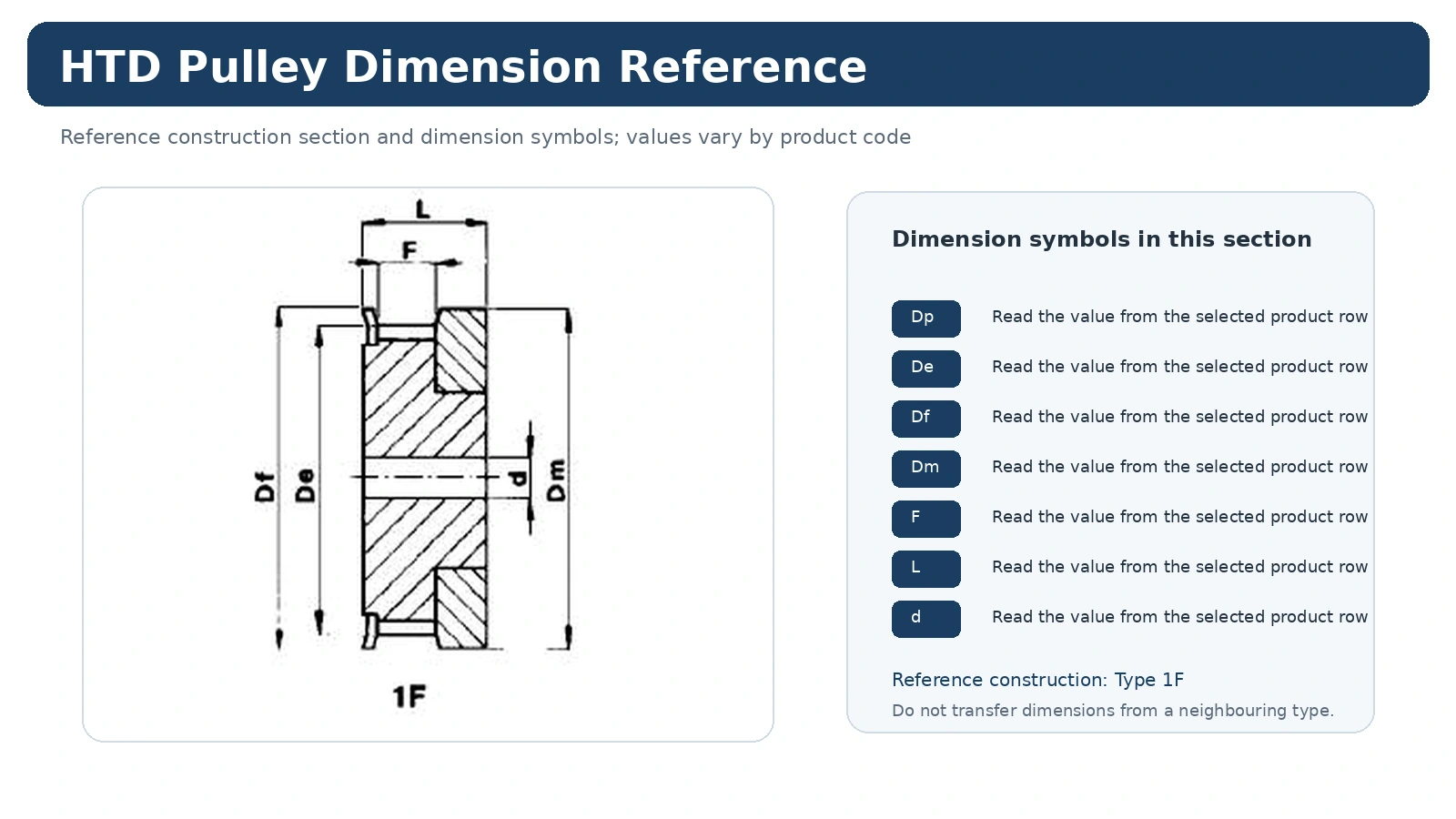
Maattekeningen moeten op volledige, leesbare breedte worden bekeken. Schaal nooit een schermafbeelding en gebruik de geschaalde afmeting vervolgens als maat; gebruik de afgedrukte waarde en het juiste constructietype.
Een storing die je beter kunt vermijden
A common error is assuming all large 14M pulleys use the same hub or bush arrangement. That can produce a part that appears close in the catalogue yet changes ratio, belt line, mounting or service access. Resolve the conflicting feature before requesting price so the quotation refers to one mechanically coherent configuration.
Als er nog twee mogelijke configuraties overblijven, stuur dan zowel de machineafmetingen en foto's als de voorkeursoptie. De offerte kan dan aangeven welke interface nog bevestiging nodig heeft, in plaats van onzekerheid stilzwijgend in een specificatie te verwerken.
Zet de technische keuze om in een offerteklaar item.
Vermeld de HTD/profielfamilie en volledige rieminformatie.
Vermeld het aantal tanden, de werkbreedte en de relevante afmetingen of tekeningreferenties.
Definieer de boring of bus, asgegevens, naafuitsteeksel en riemlijnpositie waar van toepassing.
Voeg de hoeveelheid, bestemming, benodigde documenten en de gebruikte tekeningrevisie toe aan de aanvraag.
Als een van de bovenstaande items echt onbekend is, geef dit dan aan ter bevestiging. Een precieze, open vraag is nuttiger dan een plausibele waarde die nooit is gemeten.
Veelgestelde vragen van kopers
Wat moet er als eerste bevestigd worden?
Confirm 14 mm HTD family, width code, tooth count and installation envelope. That prevents later dimensions from being compared across the wrong product family or installation route.
Welke informatie is het meest nuttig voor een vervanging?
Send 14M belt marking, tooth count, width series, shaft interface and available axial space, plus clear photographs before the old pulley is removed. The photographs preserve axial orientation and neighboring clearances that a loose part cannot show.
Wanneer moet een tekening worden gebruikt?
Gebruik een gecontroleerde tekening wanneer de catalogusregel de asinterface, de naaf-/flensconfiguratie, de afwerking, de tolerantie of de inspectie-eisen die voor de machine relevant zijn, niet volledig definieert.
Pitch Family Is Only the First Branch of the Selection
14M selection still requires working width, tooth count and mounting geometry. Tooth count changes pitch diameter and can also coincide with changes in body type, hub and material across a catalogue family. The correct comparison therefore stays row-specific after the pitch has been chosen. For a new drive, ratio and center distance must be reviewed together with available diameter and guard clearance.
For a replacement, begin with the mating belt and the installed part. If the belt identity is uncertain, avoid choosing a new family only because the measured pitch appears close. Obtain enough measurements and identification detail to identify the tooth system before comparing product rows.
When to Escalate From a Catalogue Row to a Drawing
Use a drawing-controlled order when the shaft connection, hub position, flange arrangement, material, finish or inspection requirement differs from the normal catalogue configuration. Keep standard HTD tooth geometry explicit on the drawing so the custom machining request does not accidentally obscure the mating-belt requirement.
On mixed-model RFQs, keep every width and tooth count on its own line. A general note such as “same as above” can become unsafe once one model uses a different construction type or bush.
Treat 14M Selection as an Envelope and Handling Decision as Well as a Pitch Choice
The 14M catalogue families include 14M-40, 14M-55, 14M-85, 14M-115 and 14M-170 width-series pages. These larger components deserve a deliberate envelope check because hub, flange, shaft and guard relationships can become as important to installation as the tooth count itself. Use the individual row and construction type rather than extrapolating from a smaller 14M part.
For replacement work, capture the pulley position on the shaft before removal and measure clearances to bearings, guards and adjacent components. If lifting, handling or disassembly space is limited, include that service context with the RFQ. Taper-bush configurations should be tied to the supported bush designation and actual shaft rather than selected from outside diameter.
For new drives, include ratio, center distance, transmitted duty and installation envelope. The website can identify the catalogue family and geometry, while the project data closes the machine-specific decision.
Check Handling and Installation Sequence for the Selected 14M Configuration
As the pulley envelope becomes larger, the installation sequence can matter. Confirm that the selected component can pass through the available guard opening and that there is sufficient space to position it on the shaft without disturbing unrelated components. Where lifting or support is needed, follow the machine owner’s safe handling method rather than improvising from the pulley catalogue.
The purchasing record should also distinguish the catalogue geometry from project-specific requirements. If the machine requires a particular finish, inspection report or shaft fit, add that requirement to the drawing or RFQ. Keep it tied to the exact 14M width series and tooth-count row so a future replacement does not inherit an ambiguous general note.
Plan 14M Selection Around the Full Industrial Envelope
The 14M family covers 14M-40, 14M-55, 14M-85, 14M-115 and 14M-170 width-series pages. These are physically larger components, so shaft size, hub projection, guard clearance, lifting/handling access and the selected construction type deserve the same attention as pitch and tooth count.
A large pulley can satisfy the belt-side requirements yet still be impractical to install if the hub, bush or removal space is overlooked. Replacement work should therefore include measurements from both shaft ends and the available axial envelope. For new drives, resolve the belt system and ratio first, then use the product row to control the actual pulley geometry.
Keep 40, 55, 85, 115 or 170 on the same line as the tooth count.
Compare type, hub and flange arrangement for the exact row.
Confirm straight-bore or taper-bush interface and actual shaft data.
Review installation and removal access for the selected diameter and width.
If a standard 14M row does not fit the machine envelope, use a drawing-controlled configuration rather than modifying a catalogue value informally. The drawing should identify which geometry is functional and which dimensions may remain standard.