HTD 14M Timing Pulleys are organized here by the selection variables an engineer or buyer actually needs: profile, tooth count, belt width, shaft interface and construction. Larger HTD pulley families for industrial drives where shaft interface and hub construction become especially important.
How to Navigate This Product Family
Start with the complete belt designation. Then identify tooth count or required speed ratio, belt face width and the shaft/mounting arrangement. Do not select by outside diameter alone. If this is a replacement, record hub projection and flange arrangement from both sides before comparing products.
The product cards below lead to detailed pages with catalogue tables, dimension references and RFQ guidance. Use the product grid below to open the detailed product pages and compare the available catalogue configurations in this family.
Product Options
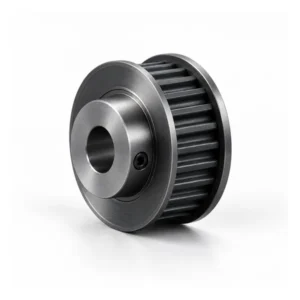
HTD 14M-115 Timing Pulley
14M curvilinear synchronous timing pulley, 14M-115 series. Select tooth count, belt width and shaft interface from the catalogue table or approved drawing.
View Details →HTD 14M-170 Timing Pulley
14M curvilinear synchronous timing pulley, 14M-170 series. Select tooth count, belt width and shaft interface from the catalogue table or approved drawing.
View Details →HTD 14M-40 Timing Pulley
14M curvilinear synchronous timing pulley, 14M-40 series. Select tooth count, belt width and shaft interface from the catalogue table or approved drawing.
View Details →HTD 14M-55 Timing Pulley
14M curvilinear synchronous timing pulley, 14M-55 series. Select tooth count, belt width and shaft interface from the catalogue table or approved drawing.
View Details →HTD 14M-85 Timing Pulley
14M curvilinear synchronous timing pulley, 14M-85 series. Select tooth count, belt width and shaft interface from the catalogue table or approved drawing.
View Details →14M Application and Duty Review
Larger HTD pulley families for industrial drives where shaft interface and hub construction become especially important. Suitability still depends on power or torque, speed, center distance, duty cycle, belt construction, environment and shaft support. For a new drive, include those values in the RFQ. For a replacement, send the old belt marking and measurements rather than assuming that every 14M curvilinear profile is interchangeable.

Compatibility and Measurement Checks
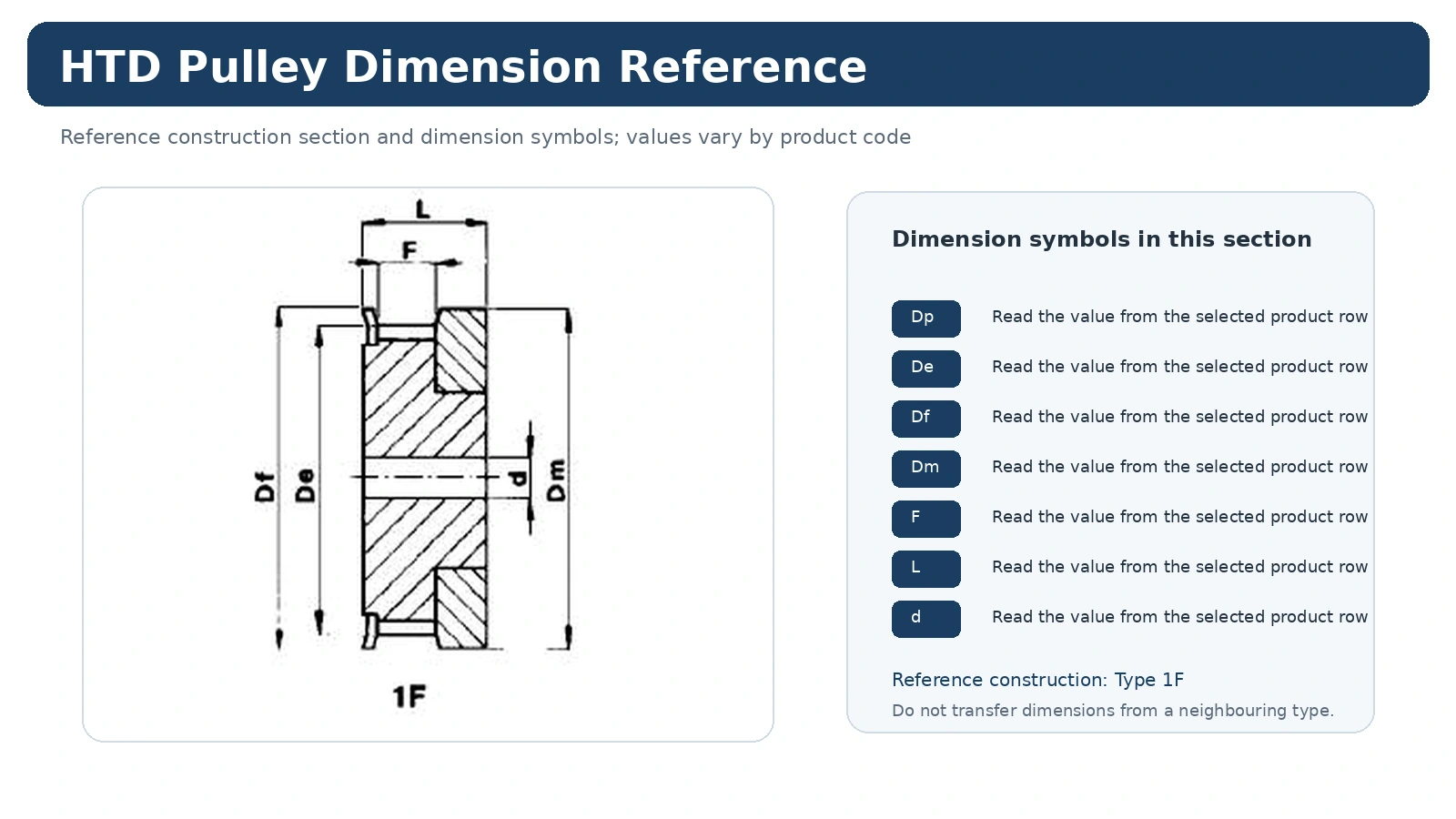
Before ordering, confirm tooth system, tooth count, working width, bore/bush, hub projection, flange arrangement and the belt-line location. Record any critical fit or runout requirement on the drawing. For replacement projects, inspect the existing pulley for wear that could distort measurements and check whether the shaft or spacer arrangement has been modified.
Related Engineering Guidance
Use the HTD pulley selection guide for a complete decision sequence, see belt and pulley matching when the belt code is known, and review application pages for machine-specific checks.
HTD 14M Timing Pulleys FAQ
What information is needed for quotation?
Send the belt/profile, teeth, belt width, shaft or bush details, quantity and destination. Include a drawing for nonstandard hub, flange, material, finish or inspection requirements.
Can an old pulley be cross-referenced from a photo?
A photo helps identify construction, but dimensions and the mating belt marking are needed before a replacement can be confirmed.
Are all pulleys of the same nominal pitch interchangeable?
No. Confirm the exact tooth family and mechanical interface. Nominal pitch alone is not enough for a replacement decision.
Before Ordering a 14M Pulley
Larger 14M components should be checked against the full installation envelope, not just the pitch family. Record tooth count, width series, shaft connection, hub projection, flange arrangement and clearances to guards or bearing housings.
Where the installation uses a taper bush, keep the supported bush designation on the same order line as the pulley. Nonstandard bore, hub, finish or inspection requirements should be drawing-controlled so the larger component can be reviewed as one defined configuration.
How to Read the 14M Family
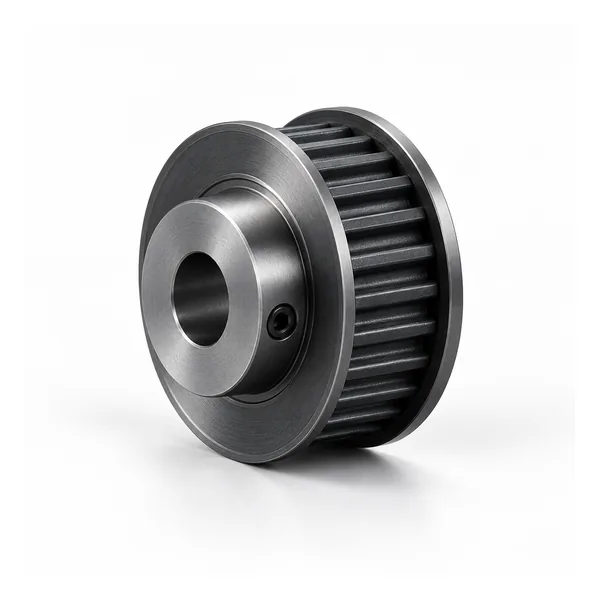
The 14M category on this site groups 14M-40, 14M-55, 14M-85, 14M-115 and 14M-170. These are working-width series within the same HTD 14M pitch family. Each series page contains the available tooth-count rows from the selected catalogue. Tooth count changes pitch diameter and may change body type, flange, hub or material details, so the individual row—not a generic family photo—controls the ordered configuration.
This family is commonly considered in larger industrial drives where hub and mounting geometry become especially important. That description is application context, not a universal load rating. New-drive suitability still depends on speed, torque or power, center distance, duty cycle, environment, belt construction, alignment and shaft support.
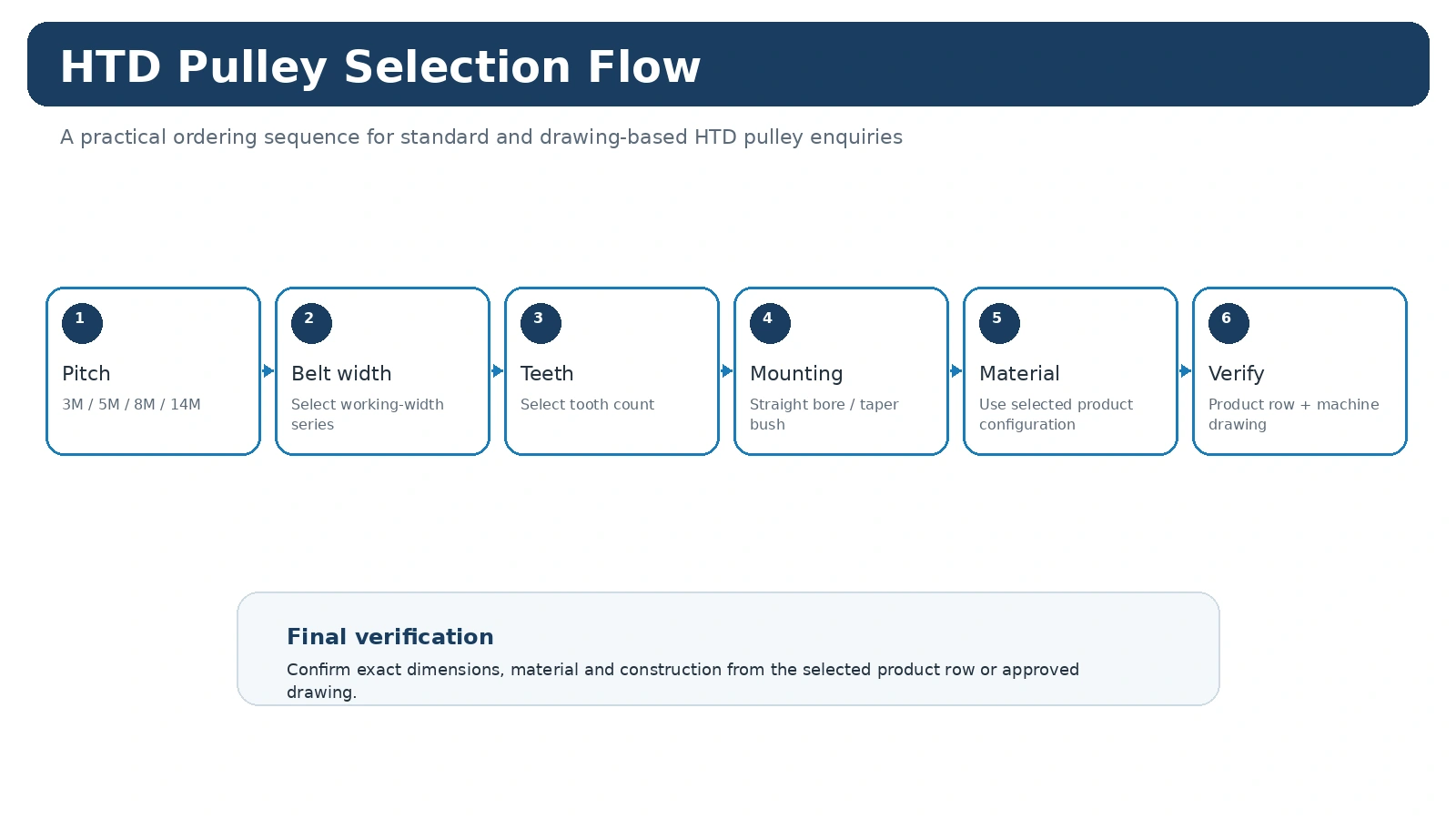
Selection Sequence for 14M
- Confirm HTD 14M at the belt. Do not substitute another tooth family because the nominal pitch sounds similar.
- Choose the working-width series. Match the belt width and machine envelope before comparing tooth-count rows.
- Select tooth count. Use the required ratio and center-distance geometry, then check physical diameter and clearance.
- Finish the shaft interface. Confirm straight bore or supported taper-bush construction, bore/bush details, hub projection and flange arrangement.
- Release the exact row or drawing. Add material, finish or inspection requirements only where the project controls them.
Replacement Checks for 14M Pulleys
Before removing an existing pulley, photograph the belt marking, both faces of the pulley, the hub orientation and the belt line. Count the teeth directly where practical, record the working-face width, and measure the shaft interface and overall axial envelope. Outside diameter alone is not enough to identify the family because different tooth systems and construction types can overlap in apparent size.
If a catalogue row is found, compare all assembly-critical fields, not just tooth count. Hub position, flange arrangement and the available bore or bush can determine whether a mechanically compatible belt-side geometry will actually install in the machine.
RFQ Data for the 14M Family
Send the complete belt marking or confirmed HTD 14M identity, series width, tooth count, straight-bore or taper-bush requirement, shaft data, quantity and destination. Add a drawing for nonstandard hubs, flanges, bores, keyways, finishes or controlled inspection characteristics. If the old part is unknown, send clear photos and measurements rather than assigning an approximate product code.
Family-Specific Review for HTD 14M
Within the HTD 14M range, large diameters, hub geometry and installation access become increasingly important. Check handling space, guards and the ability to fit or remove the pulley from the shaft before release.
When comparing replacements, record the belt line relative to a fixed machine datum. A pulley that matches tooth count and shaft diameter can still move the belt if the hub projection or flange arrangement differs. If the catalogue row is not an exact fit, send the existing dimensions and use a drawing-controlled custom review rather than machining a standard part without checking the remaining wall, hub and alignment requirements.
For purchasing, keep model, tooth count, mounting definition and quantity on each line. This makes it possible to combine several models in one order without losing the technical identity of any item.