Send the most complete product and machine information you have. A clear RFQ can usually be reviewed faster when the belt identity, pulley geometry, shaft interface and order quantity are kept together.
What to Include in Your Enquiry
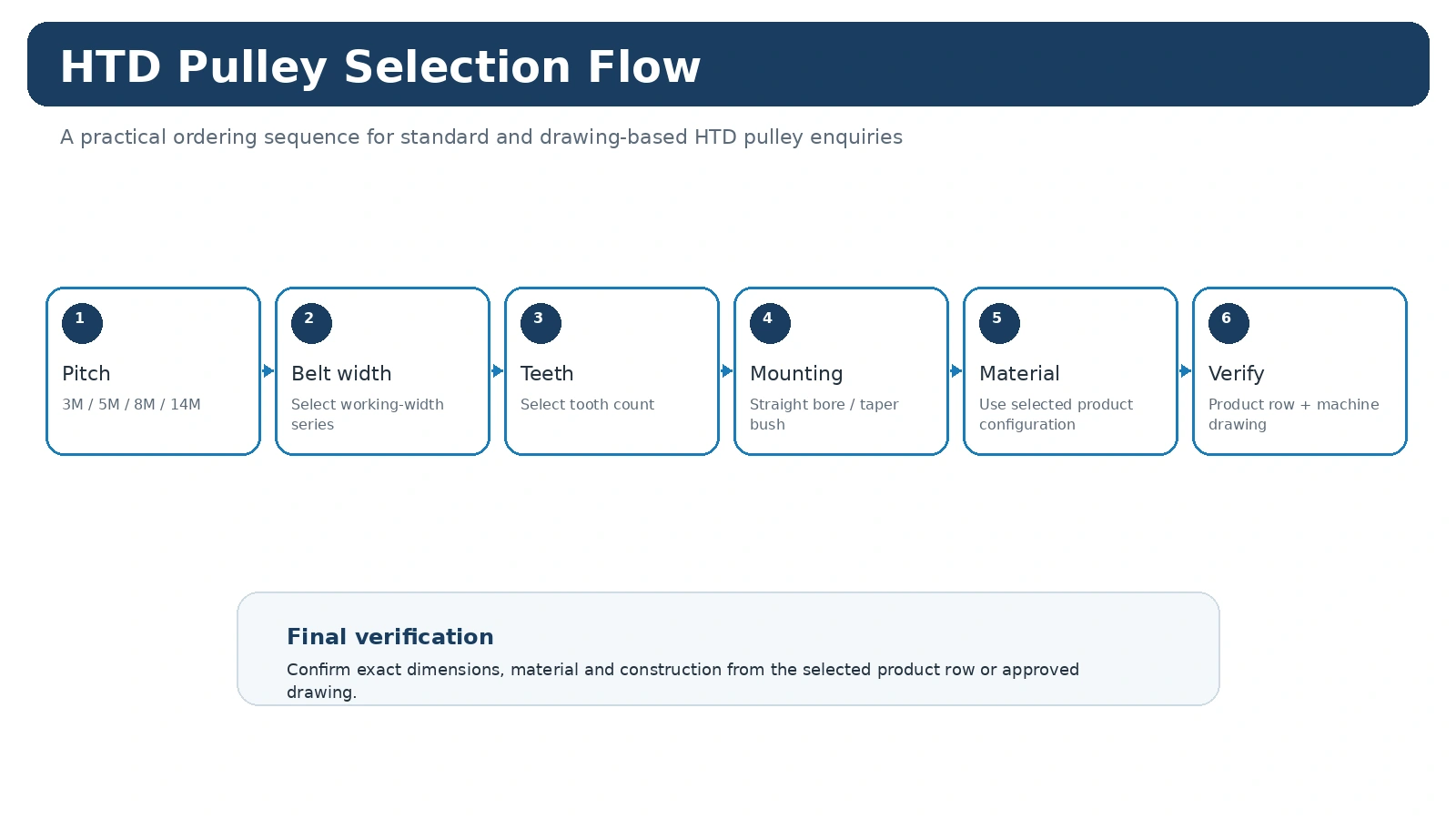
- HTD profile: 3M, 5M, 8M or 14M
- Required tooth count or existing speed ratio
- Belt working width / pulley width series
- Shaft diameter, bore, keyway or taper-bush requirement
- Hub projection and flange arrangement when they affect the fit
- Quantity by model and destination country
- Drawing, replacement photographs or controlled inspection requirements
MOQ and Sample Guidance
Standard parts are normally planned around production-quantity minimums. Higher-value or larger items can be reviewed against the practical order value. New clients may request 1–5 evaluation samples at sample pricing when the configuration and manufacturing route are suitable. Multiple models can be combined toward an order value of about USD 1,500. Special materials and special processes follow their own production minimums.
Our focus is industrial and OEM supply rather than one- or two-piece retail replacement orders. Very small quantities are considered only for qualified engineering validation or a paid sample requirement, where unit pricing will be higher.
Not Sure of the Exact Pulley Code?
For an existing drive, send photographs before disassembly, the belt marking, tooth count and measurements from both pulley faces. For a new machine, send driver speed, driven speed or ratio, load information, center distance, duty cycle and the shaft arrangement. We can then identify which catalogue family or custom-drawing route is appropriate for quotation.
Standard parts are typically planned at 10–25 business days, custom components at 20–45 business days, and project-based assemblies or related equipment at 45–120 business days where applicable. Final timing is confirmed only after drawing, material, quantity and production-route review.
Commercial Terms Are Confirmed With the Shipment Plan
EXW, FOB, CIF and DAP are commonly supported. FCA, CFR, CPT, CIP and DDP can be discussed for suitable destinations and shipment arrangements. The final Incoterm, packing method and logistics scope are confirmed on the quotation rather than inferred from the website.
Korea Contact Point
A Complete RFQ Usually Avoids a Second Measurement Round
For a catalogue pulley, the fastest RFQ starts with the belt marking or confirmed HTD family, working-width series and tooth count. Add the shaft diameter, finished bore or taper-bush designation, plus quantity and destination. When an old pulley is being replaced, front, rear and side photographs help establish hub projection, flange arrangement and the belt line. A dimensioned sketch is preferable when the machine has little axial clearance.
For a custom pulley, mark the nonstandard features directly on the drawing. State material or finish only when they are controlled requirements. If inspection documentation is required, identify the characteristic that needs recording rather than asking for a generic certificate that does not show the functional dimension.

Planning Quantities and Delivery
Standard catalogue parts are normally quoted with a production-quantity MOQ. Larger or higher-value items may instead be reviewed against the practical order value. Qualified new-client samples of 1–5 pieces can be considered at sample pricing when the configuration is suitable. Mixed models may be combined toward approximately USD 1,500. Special materials, heat treatment, finishes or other dedicated processes follow the minimum quantity needed for that process. Retail-style one- or two-piece replacement orders are not accepted; very small quantities are reserved for qualified sample or engineering-validation cases.
Typical planning ranges are 10–25 business days for standard parts and 20–45 business days for custom components after technical release. Project-based equipment, when part of a broader supply scope, may require 45–120 business days. EXW, FOB, CIF and DAP are commonly supported; FCA, CFR, CPT, CIP and DDP can be discussed for suitable shipments. Final timing and terms are confirmed with the reviewed specification, quantity and destination.