Straight Bore vs Taper Bush HTD Pulley: Compare two supported mounting families by machine interface and service needs.
What This Decision Controls
Compare two supported mounting families by machine interface and service needs. The decision should be documented with the belt designation, product code or drawing because a timing pulley is part of a drive system. A visual match does not prove tooth compatibility or shaft fit.

Recommended Workflow
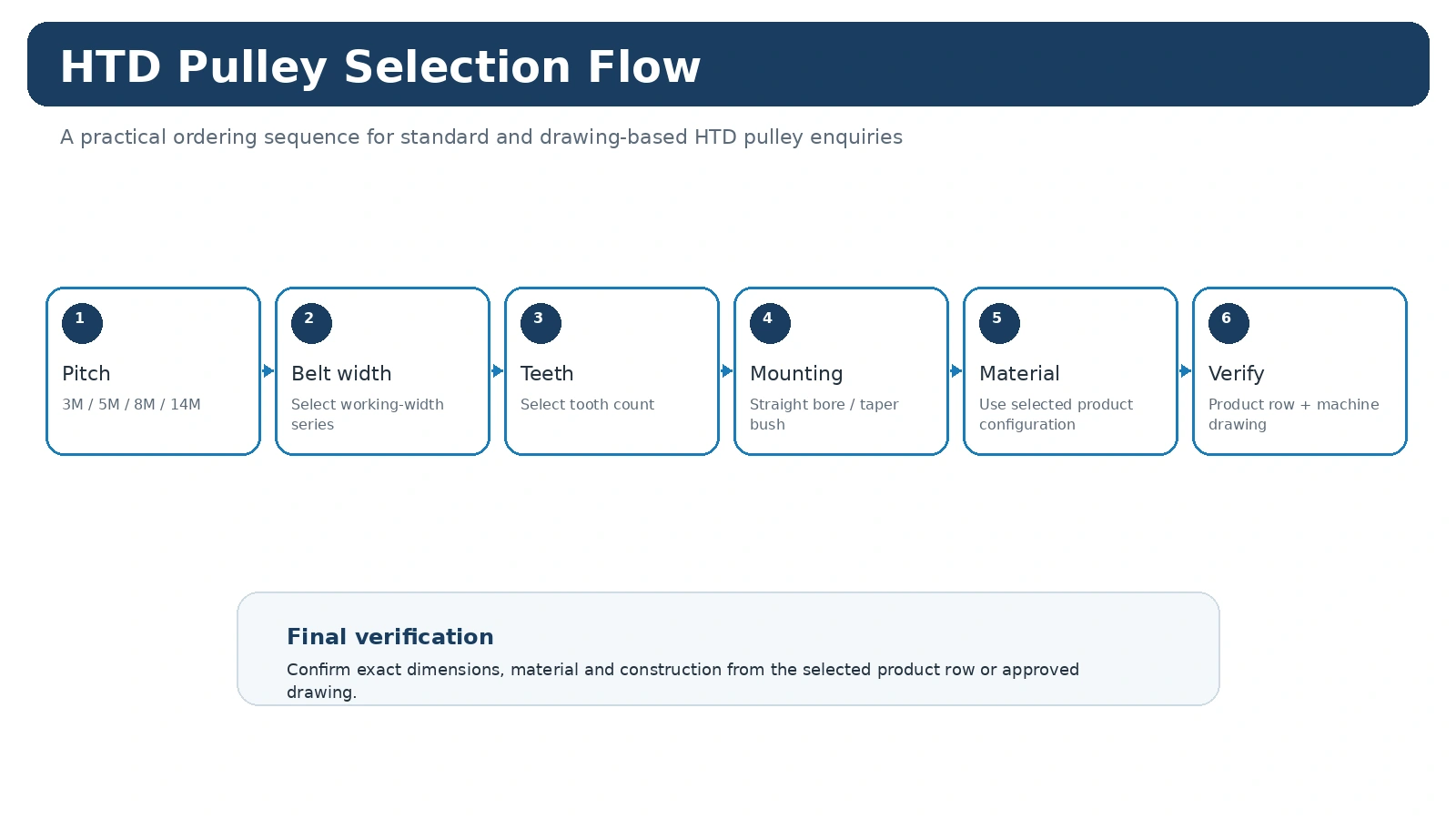
Start with the mating belt and drive requirement. Confirm pitch/profile, tooth count and working width. Then check the shaft interface, hub and flange envelope, material and any controlled inspection requirement. For a replacement, measure the old part from both sides and record the belt line relative to a stable machine datum.
Common Errors to Avoid
- Choosing by outside diameter while ignoring the tooth system.
- Assuming that every curvilinear profile with the same nominal pitch is interchangeable.
- Measuring only one side and missing hub projection or an offset belt line.
- Leaving bore fit, keyway, bush code or inspection requirements until after quotation.
- Using a universal belt-tension or tolerance value without the machine and belt design basis.
Use the Guide in an RFQ
Once the key variables are captured, open the HTD product families, compare the relevant application context, or send the drawing and order details through the form below.
Mounting Route Is Part of Serviceability
Straight-bore and taper-bush products can share the same HTD pitch yet require different shaft data and removal space. Record the actual shaft, hub envelope and maintenance access before deciding which mounting path belongs in the machine.
If a standard row does not define the required finished bore or other shaft-interface detail, use a controlled drawing. For taper-bush versions, keep the exact bush designation tied to the pulley row.
Mounting Choice Changes the Shaft Interface, Not the HTD Family
Both constructions can belong to the same HTD pitch, but they use different mounting details and may not exist in every width/tooth-count combination. Verify the exact row and available axial space before substitution.
When the decision involves an existing machine, keep measurements, catalogue values and new project requirements separate. This prevents a field measurement from being silently treated as a nominal dimension or a desired change from being mistaken for a standard family feature.
Use the Drawing and Table Together
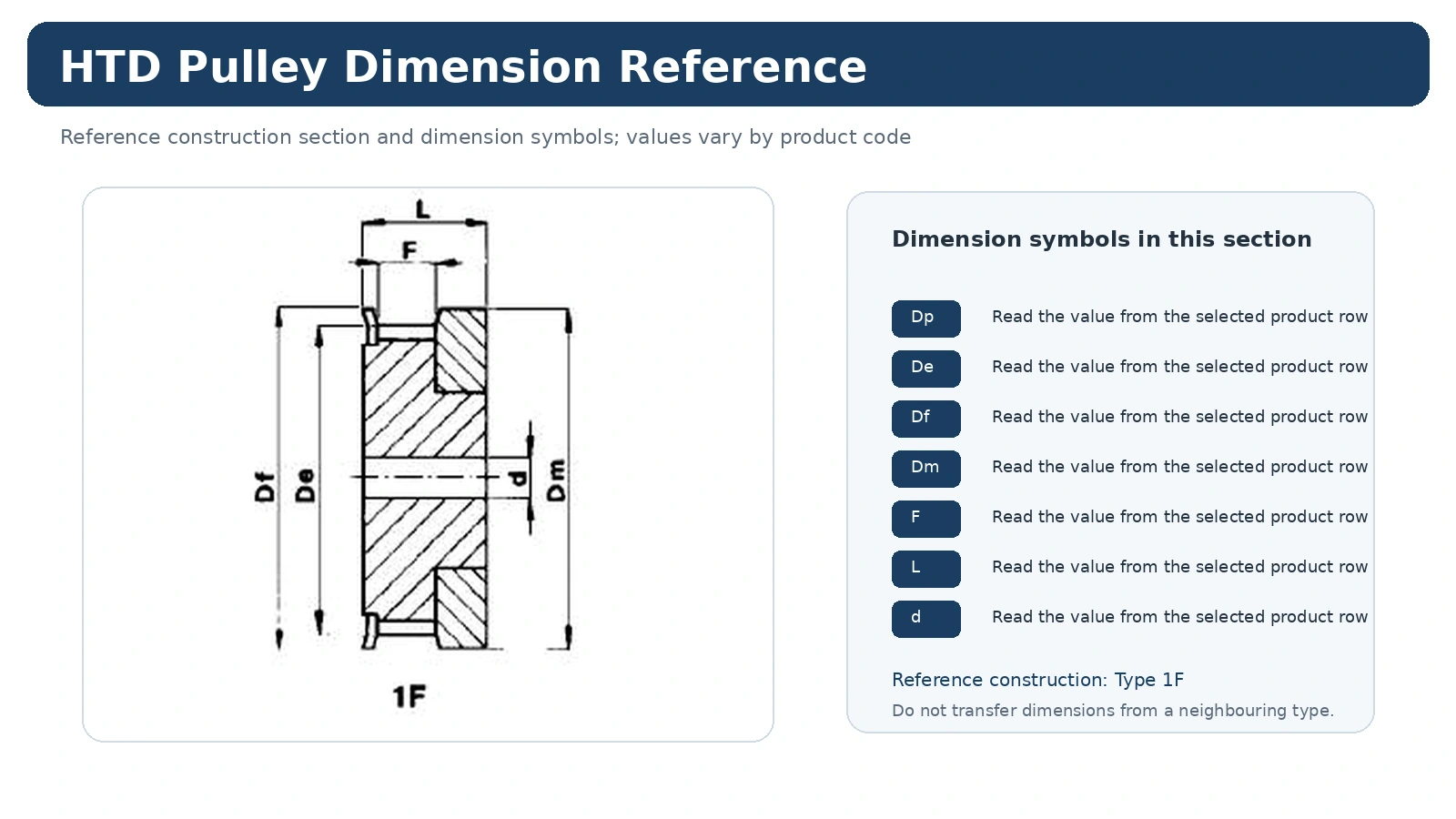
Construction drawings explain the symbols and relationships. The row-specific table provides the actual values for the selected model. Do not scale the illustration or transfer dimensions from another width or tooth count simply because the product looks similar.
Where the catalogue does not control a required fit, runout, tolerance, finish or document, put that requirement on the project drawing or RFQ and make it part of the order review.
Release Checklist
Keep the belt/profile identity, working width, tooth count, mounting definition, quantity and drawing revision on the same technical order line. Add machine duty for a new drive or clear photographs and measurements for replacement work. This gives purchasing a configuration that can be checked instead of a collection of disconnected dimensions.
What This Guide Does Not Replace
This guide helps organize the selection and measurement process; it does not replace the exact product row, belt data or project drawing. If a required power, torque, speed, fit, tolerance or service limit is not stated in the relevant catalogue table or approved drawing, keep it as a design or RFQ input and verify it for the actual drive.
That boundary is useful during procurement because it prevents a general engineering explanation from being quoted later as if it were a guaranteed value for every HTD pulley configuration.
Apply the Straight-Bore Versus Taper-Bush Selection to a Real Machine
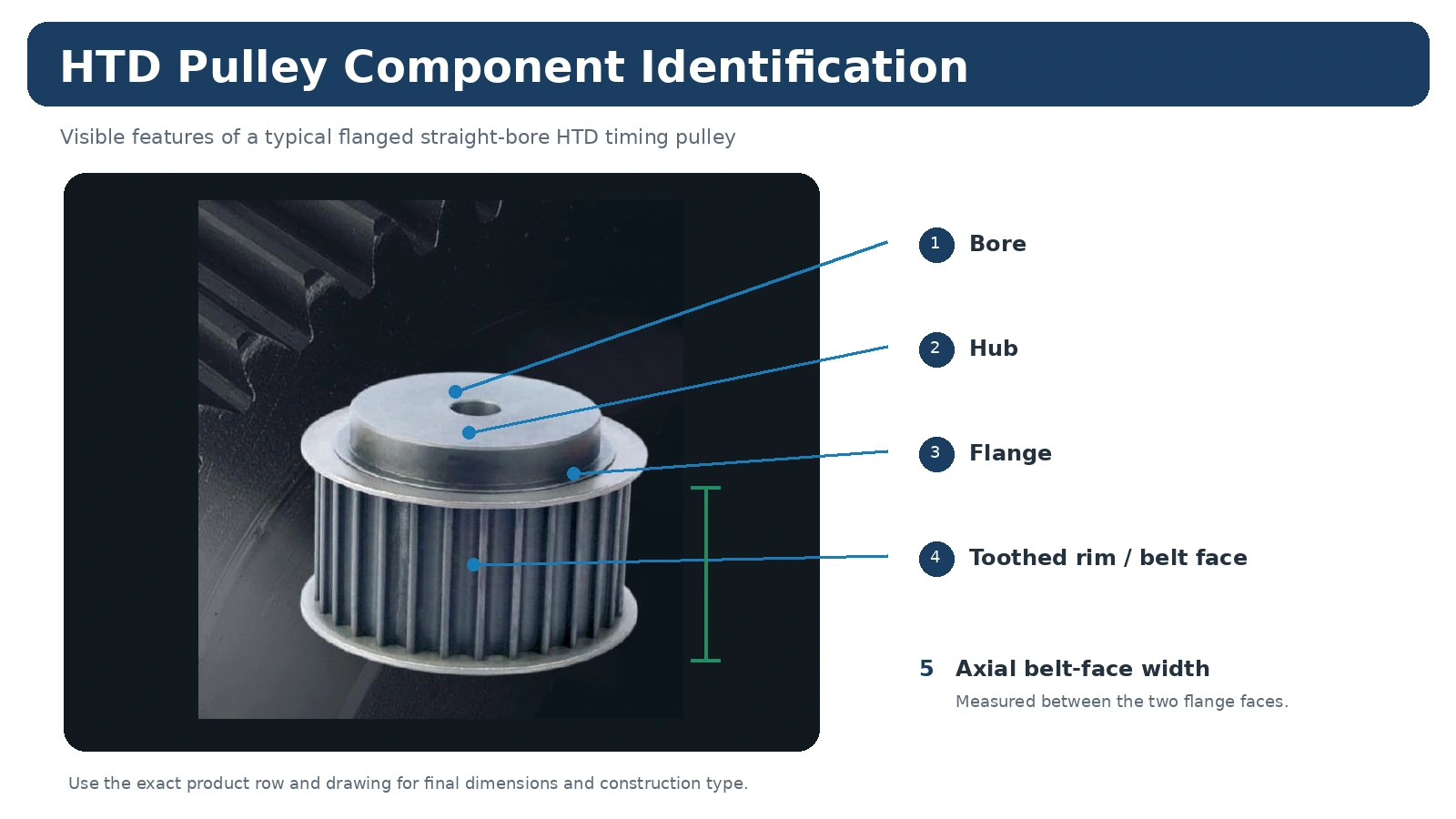
Collect shaft size, removal access, bush code where applicable, hub envelope and service method. Use the catalogue or dimension drawing to name features consistently, then separate measured machine values from catalogue values. The working rule is simple: choose the mounting route from the machine interface, not from a visually similar pulley. If the old component is worn or modified, treat its measurements as field data rather than assuming they are the original nominal dimensions.
For replacement work, compare both front and rear hub relationships and note which face establishes the belt line. For a new design, record the speed relationship, center distance, duty and installation envelope before the product code is selected. This keeps the selection traceable when the drive is serviced later.
Use the Drawing to Close Remaining Gaps
A standard product row can define pitch family, tooth count and many envelope dimensions, but project-specific shaft fits, key details, hub changes, finishes or inspection limits may still require a drawing. Show the machine datum and the dimensions that actually control assembly rather than filling the drawing with uncontrolled reference dimensions.
If two catalogue configurations appear possible, identify what is still unknown and measure that feature directly. This is more reliable than choosing the configuration with the closest outside diameter or the most familiar photograph.
Release Data for Straight-Bore Versus Taper-Bush Selection
Keep the complete product identity with the purchase line: HTD family, width series, tooth count, bore or bush, quantity and the drawing revision where one is used. Add order-specific material, finish, inspection or documentation requirements separately. This makes later replacement work easier because the accepted configuration can be recovered without reconstructing the decision from email history.
Choose the Mounting Route Before Final Bore Review
Straight-bore and taper-bush pulleys solve different shaft-interface and serviceability requirements. For a taper-bush option, retain the exact bush number associated with the selected tooth-count row and confirm the permitted bore range rather than substituting a bush by nominal shaft size alone. For straight-bore work, define the finished shaft interface on the order or drawing. Also check access for installation and removal, because a mechanically valid hub can still be impractical in a guarded or tightly packaged machine.